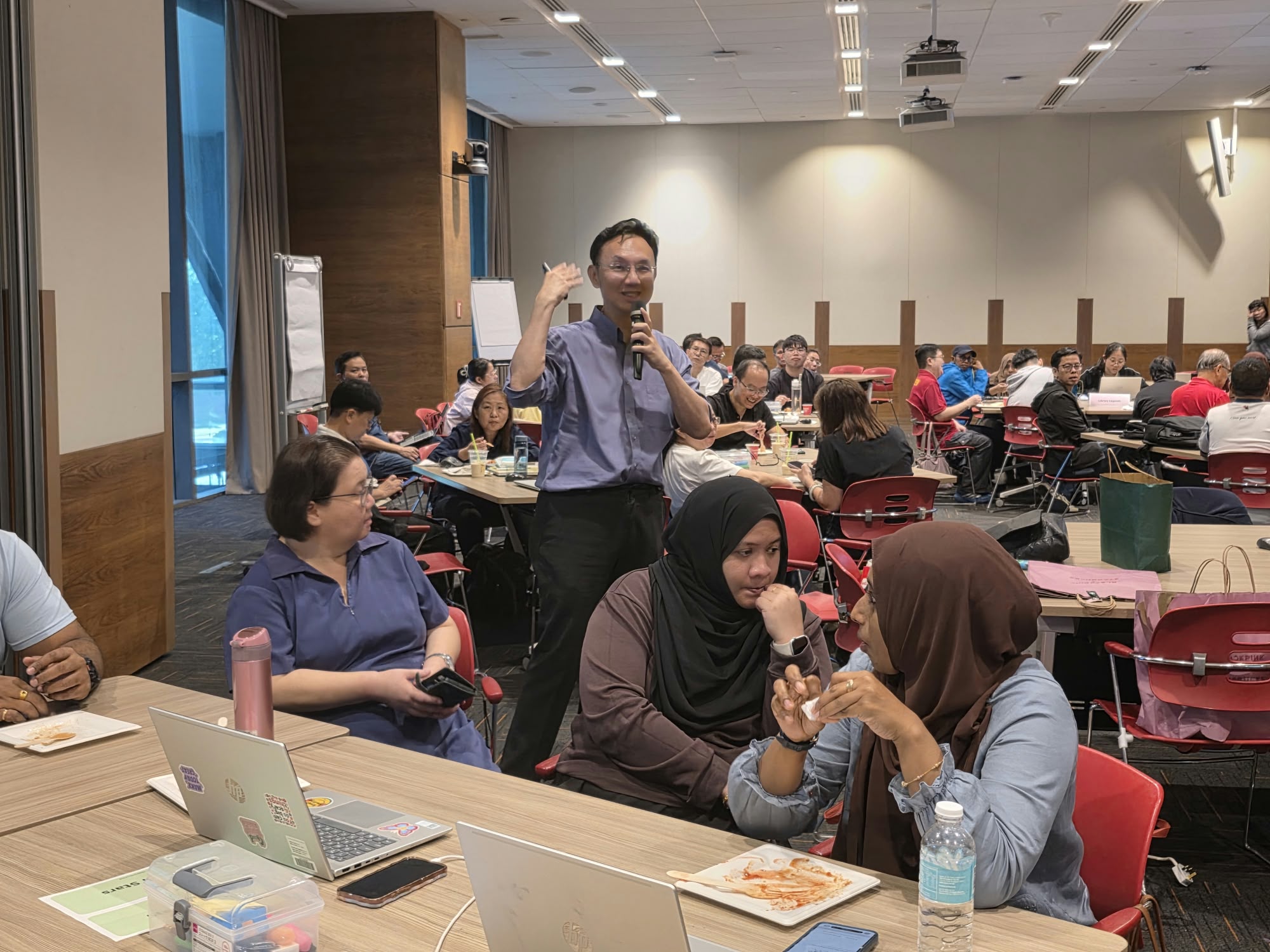
On 17 November 2026, Prof. Ben Leong, Director of the AI Centre for Educational Technologies (AICET), spoke to the staff of Evergreen Secondary School on preparing students for an AI-driven future.
Prof. Ben opened by making clear that he was not there to persuade teachers to use AI in their teaching. Instead, he framed the talk around three questions facing schools: whether today's students will still have jobs, what schools should teach, and how AI should be used in learning.
AI and learning: a question of discipline
Prof. Ben began with the growing concern over AI's effect on learning. He pointed to recent research, including a June 2026 study that followed nearly 27,000 secondary school students in China over 30 months, as well as moves in several countries to restrict children's access to AI.
At the centre of this concern is cognitive offloading, where students hand thinking over to AI before they have built the underlying skills. Prof. Ben argued that this is not fundamentally a cognitive problem. Rather, it is a problem of discipline and self-regulation, and one that schools are well placed to address.
Jobs in a global market
On employment, Prof. Ben suggested that students need not fear AI itself. The larger challenge, he said, is global competition: a growing number of young people worldwide are entering the workforce, and there may not be enough jobs to go around.
He noted that Singapore's students will be competing not with the average worker in a lower-cost country, but with that country's most capable people, now enhanced by AI. Workers who use AI well are likely to pull further ahead of those who do not. Against this backdrop, he encouraged schools to help students stay open to careers beyond traditional white-collar roles.
What to teach, and how to use AI
On what schools should teach, Prof. Ben observed that much of the current discussion is not new to education. The priorities remain teaching students how to learn, how to ask the right questions, how to embrace ambiguity and how to see things from others' perspectives. These human skills are where AI is weakest and where teaching and assessment are hardest. He added that AI itself can help schools teach and assess them, while acknowledging the open question of how to balance them against academic results.
For students, he offered a simple approach to using AI well: think first, use AI second, and reflect afterwards. Students should attempt a task on their own before turning to AI for hints, explanations or feedback, then revise in their own words and explain what they changed and why.
For teachers, Prof. Ben suggested that meaningful gains will come from redesigning the learning experience rather than adding AI to existing workflows. He illustrated this with a leadership course he is teaching this semester, in which students practise coaching conversations through an AI role-play, reflect on their approach and receive AI-generated feedback.
Teaching as a craft
Prof. Ben cautioned that AI does not make anyone a good teacher, and can make a weak teacher worse. He described AI as a force multiplier: in the hands of someone with good judgment it amplifies their work, but without that judgment it risks producing more low-quality output and a convergence to mediocrity.
For this reason, he urged teachers to focus on craftsmanship. Domain mastery and judgment will matter more as AI widens inequality, and teachers and students alike need to know what good work looks like.
Character and values
Prof. Ben closed by returning to the purpose of education: guiding students to lead good lives. He called for a stronger focus on character education and values, citing the principle of 教书育人, and a 1967 speech by Mr Lee Kuan Yew warning that a literate generation without values may be more dangerous than an uneducated one.
He ended on the point that teaching, ultimately, is about heart. The session concluded with a question-and-answer segment with staff.
AICET thanks Evergreen Secondary School for the invitation.