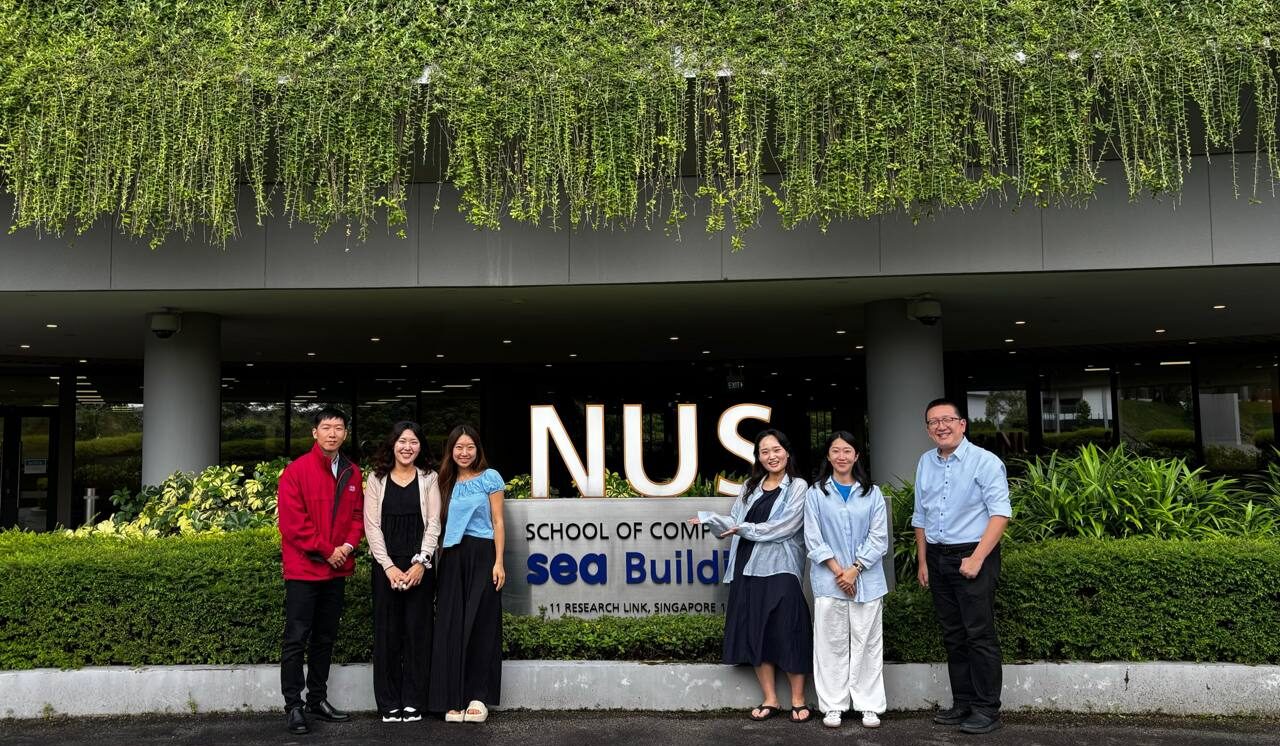
On 30 July 2026, AICET welcomed a delegation of elementary school teachers from South Korea, representing Dongin Elementary School, Dalseong Elementary School, Hwangguem Elementary School, and Suchang Elementary School. The visit was led by Prof. Soo Yuen Jien, AICET’s Deputy Director (Pedagogy), and Jonathan Chen, AICET’s Deputy Director (Engineering).
Reimagining Pedagogy and Disciplines
Prof. Soo opened the discussion by framing NUS’s approach to AI as one of open adoption paired with careful human oversight. He explained that educators typically transition through distinct phases of AI adoption: starting with basic tool awareness, moving into practical prompt and assessment design, and eventually building customized course tools.
To help teachers evaluate when and how to integrate AI, he introduced a simple framework asking whether a tool should improve an existing process, co-create alongside a human, or handle a task entirely. He illustrated this with NUS examples, such as Law modules using AI for trial advocacy practice and Physics modules where students hone scientific inquiry by attempting to persuade a chatbot. He also noted how AI is reshaping entire disciplines—from AlphaFold in biology to machine-assisted mathematical proofs.
Reframing the Question: Engineering Sound Pedagogy
Jonathan framed his sharing with these core questions:
- How can we use AI to teach better?
- What can we teach with AI, and what can’t we?
- How can we use AI to teach ‘human’ skills?
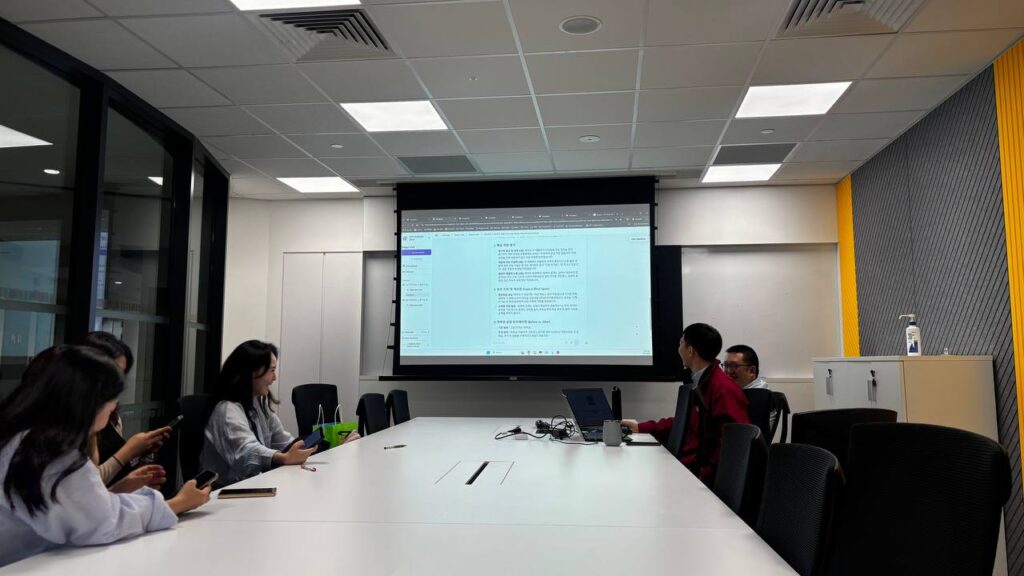
To demonstrate this in practice, he shared two AI role-play tools built with NUS faculties: a Parent Engagement Bot, where trainee teachers practice empathy and communication with a simulated parent concerned about her daughter’s career paths, and a coaching bot based on the GROW model, which guides users through workplace management scenarios.
Jonathan also addressed the challenges of automated feedback, sharing key takeaways from a biology assessment exercise. The team learned that AI feedback is far more reliable on tightly scoped questions, rubrics require continuous revision to catch edge cases, and keeping a human in the loop remains essential. To streamline this process, AICET is developing a “playground” tool that lets instructors test and refine rubrics against sample student answers.
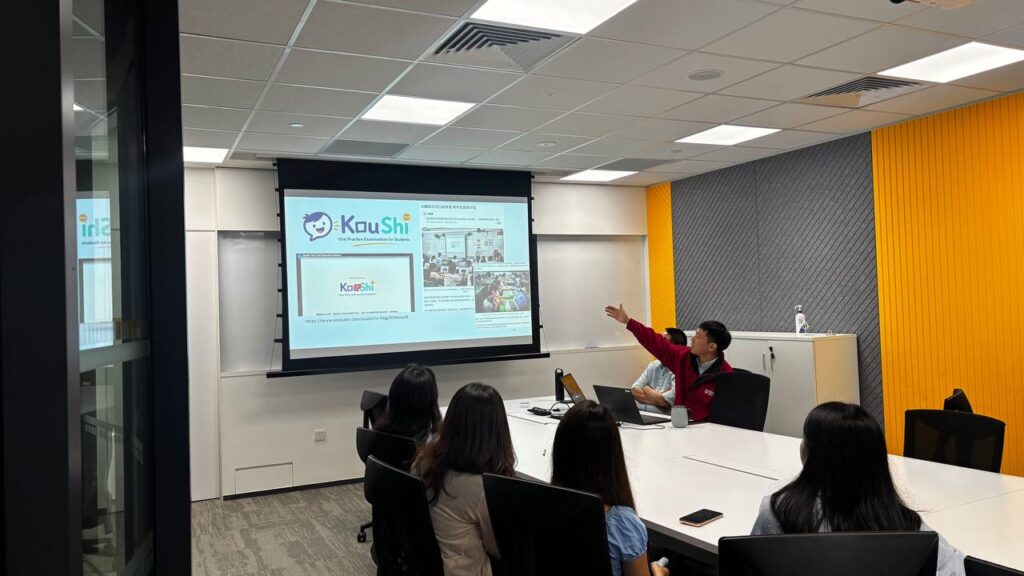
On the assessment front, he highlighted the growth of Koditsu, AICET’s online platform, which has already supported over 1,000 coding assessments and 500 live or AI-conducted interviews. He also pointed to KouShi, AICET’s newly launched AI Chinese oral examination platform, as another example of this same principle in action — giving students more frequent, realistic opportunities to practice spoken Chinese ahead of oral exams.
Preserving Critical Thinking in an AI Era
During the Q&A segment, the visiting teachers raised a vital concern:
Could an over-dependence on AI tools cause students to lose opportunities for critical thinking?
Prof. Soo addressed this by emphasizing that educators must guide students to navigate AI without stripping away the cognitive effort. He drew a parallel to calculators, noting that while they automate raw computation, they do not stop students from understanding math or thinking for themselves. Building on this, Jonathan highlighted that evaluating AI output requires active judgment—students must assess whether an answer is accurate, logical, and comprehensive, a task that inherently demands prior knowledge and learning. Ultimately, AI enhances the learning journey—acting as a scaffold rather than a replacement for guidance.
A Shared Vision for the Road Ahead
Prof. Soo and Jonathan closed the visit with a final message: technology may redefine the tools in the classroom, but it will never replace the human touch at its core. As AI continues to evolve, one fact remains clear: no matter how sophisticated the algorithm, the teacher remains the indispensable pulse of education.