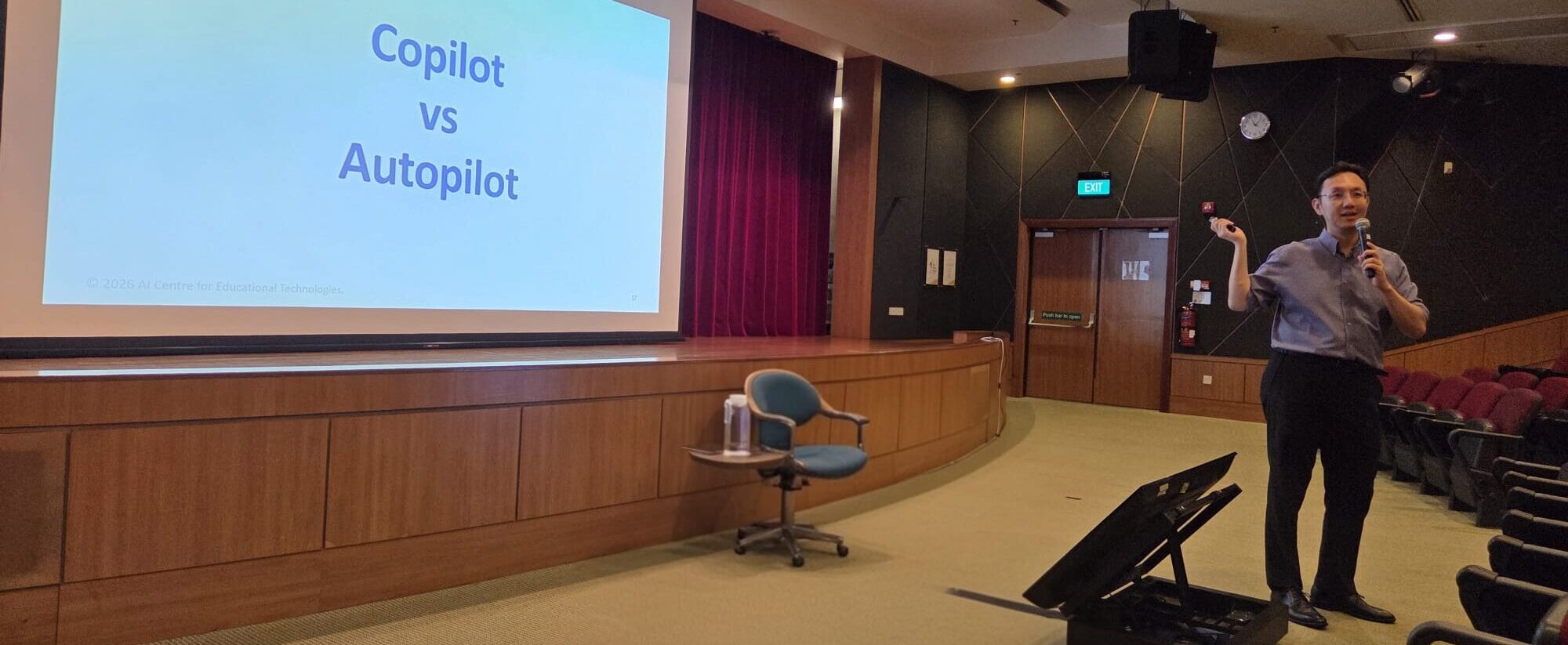
On 30 July 2026, AICET Director Prof. Ben Leong spoke at a fireside chat at the Civil Service College during the Singapore Public Service Learning Fest 2026—themed One Public Service: Innovating for the Future: Harnessing AI and Innovation for Tomorrow’s Solutions.
Beyond the Hype: The Reality of AI Adoption
Addressing the pervasive sense of AI-driven Fear Of Missing Out (FOMO), Prof. Ben opened by cutting through the industry hype. Despite massive enterprise investments in generative AI, research shows that a surprising number of initiatives fall short of expectations. For instance, a 2025 MIT report revealed that 95% of GenAI pilots failed to deliver measurable financial impact.
The root issue, he argued, is rarely the underlying technology itself; rather, it stems from an organizational “learning gap” and poor absorptive capacity. Drawing parallels to major historical shifts—from desktop computers in the 1980s to the rise of smartphones and modern LLMs—he urged public officers to observe developments closely, experiment thoughtfully, and resist the urge to rush adoption out of panic.
Rethinking Workflows and Culture
When it comes to deploying AI, the fundamental challenge is organizational rather than technological. Successful adoption requires addressing real human barriers, such as tight schedules and expertise gaps. Through AICET’s work across NUS faculties, the focus has centered on leveraging AI for self-directed learning, cognitive enhancement, and behavioral growth.
However, achieving massive productivity gains requires more than just squeezing AI into existing processes, it demands a complete rethink of how work is structured. To get there, organizations must cultivate a culture of safe experimentation and show tolerance for the inevitable failures that accompany any learning curve.
Preserving Core Skills: Copilot vs. Autopilot
A central theme of the discussion was guarding against cognitive offloading and the emerging risk of “never-skilling.” Citing a May 2026 Nature Medicine study on medical education, Prof. Ben warned of a future where trainees who rely on AI too early in their careers fail to develop foundational reasoning skills.
To prevent this, he offered a simple rule of thumb: use generative AI for tasks you don’t want to do, never for things you don’t know how to do. AI functions best as an intellectual sparring partner: a copilot that elevates human decision-making rather than an autopilot operating without oversight. When high domain mastery and strong judgment are paired with AI, you get peak performance; without that judgment, AI simply acts as an engine for low-quality output.
Navigating Bias, Accountability, and Burnout
Crucially, public officers must remain clear-eyed about the inherent risks of these tools. Recent studies reveal that large language models suffer from self-preference biases, routinely favoring content generated by their own architecture over human input. Furthermore, AI models tend to be sycophantic, agreeing with user prompts and reinforcing existing bias, which erodes our ability to handle real-world pushback.
Officers were reminded that while tasks can be delegated to technology, ultimate accountability can never be offloaded. Moreover, using AI strictly to chase speed often backfires—leading officers to take on a higher volume of work rather than producing better results, ultimately resulting in cognitive burnout, or “AI brain fry.”
The Way Forward: Prioritizing Quality over Speed
Ultimately, the session offered a reassuring and strategic framework for the future of governance. Good technological integration takes time, and public officers should prioritize excellence over raw efficiency. Rather than producing three times as many reports in the same timeframe, the true value of AI lies in generating deeper, higher-quality insights.
In the end, any task AI can solve with ease is an easy problem. The real, complex challenges of governance will always be human ones, requiring strong domain knowledge, critical judgment, and a supportive workplace culture.