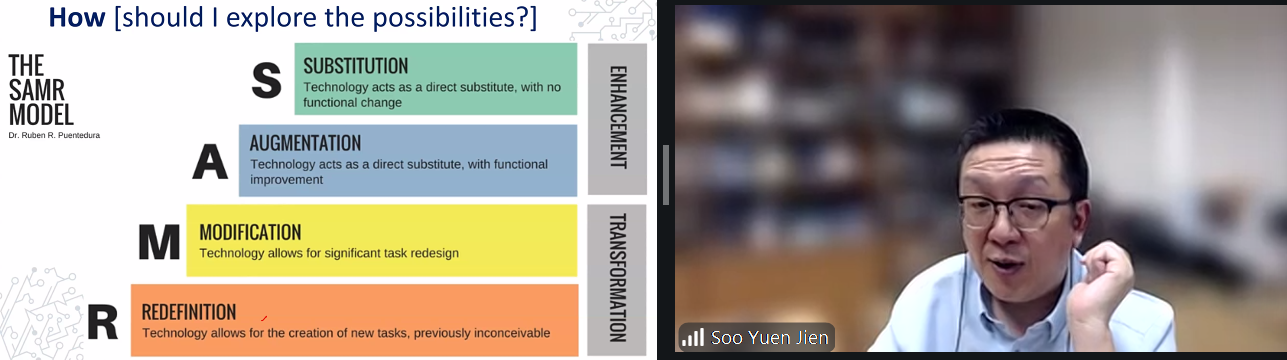
On 2 October 2026, Prof. Soo Yuen Jien, Deputy Director (Pedagogy and Research) at AICET, spoke at the first webinar of the Work-Study Technology & AI Pedagogy Special Interest Group (SIG), titled AI Governance & Responsible Practice.
The webinar opens a three-part series on how technology and AI can enhance teaching and learning across Continuing Education and Training (CET), part-time and work-study programmes. The SIG is supported by the Teaching Enhancement Grant (TEG-SIG) from the Centre for Teaching, Learning and Technology (CTLT) at NUS.
Prof. Soo covered three areas: the NUS AI policy, integrating AI into teaching and learning, and AI-powered simulations developed by AICET.
Integrating AI into Teaching and Learning
Prof. Soo began with the NUS Policy for Use of AI in Teaching and Learning, which takes a stance of embracing AI transparently and responsibly. He highlighted key ideas such as keeping a human in the loop and the principle that AI detector results are not conclusive evidence.
He then shared how educators can use AI across course content, assessment and learning activities, from Socratic dialogue and guided practice to role-play. He encouraged designs where AI creates with learners rather than for them, supporting engagement, authenticity and higher-order thinking. He also noted how AI is reshaping disciplines and curricula, an area NUS addresses through its X+AI Competency Framework.
AI-Powered Simulation
The final segment showcased AI-powered simulations developed by AICET, whose platforms now reach 7,000 to 10,000 students annually. Prof. Soo noted that as AI grows more capable, human skills such as communication, coaching and judgement become more critical, and simulations give learners a safe space to practise them. Many of these run on ScholAIstic, which pairs a large language model and a course knowledge base with role-play and guidance.
Participants were invited to try a manager coaching simulation, in which they coached an AI-simulated employee through a workplace challenge and received AI-generated feedback on their approach.
Prof. Soo also shared how simulations are being used across NUS:
- Business: In an MBA financial management course, students act as investment banking associates preparing an IPO pitch deck. They interview three AI executives (a CEO, CFO and CPTO), each holding only part of the picture, and refine their questions using feedback between interviews.
- Dentistry: An AI tutor guides students through describing radiographic features, identifying disease categories, and proposing and justifying diagnoses, giving every student more opportunities to practise diagnostic reasoning.
- German language: Simulated everyday scenarios let students practise conversations, adjust tone and register, and retry after feedback in a safe, non-judgemental setting.
AI as a Force Multiplier
Prof. Soo closed by describing AI as a force multiplier whose value depends on human judgement and domain expertise. He encouraged educators to give AI a try while staying mindful of its risks. The series continues with two further webinars: Assessment in the Age of AI Agents and AI-Enabled Curriculum & Learning Design.
AICET thanks the Work-Study Technology & AI Pedagogy SIG and CTLT for the invitation, and the 200 participants who joined the session.