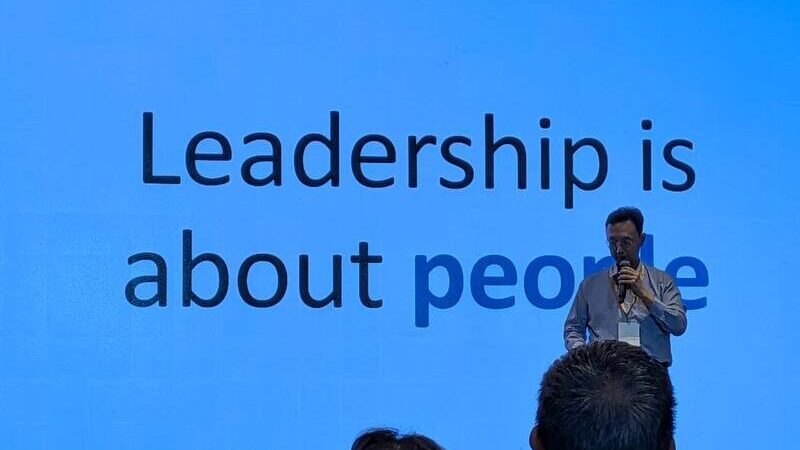

On 29 October 2026, AICET Director Prof. Ben Leong spoke at the Digital:NEX Asia Tech Conference 2026. His talk, “Better, Not Faster: Getting AI Adoption Right!”, addressed a question many organisations are now facing: how to deploy AI in a way that delivers lasting value.
Prof. Ben structured the talk around four themes: the current state of AI, how organisations should deploy it, its impact on work and learning, and the risks that come with it. His central argument was that effective AI adoption is a people problem, not a technology problem.
Pay attention, but don’t FOMO
Prof. Ben opened by examining the “fear of missing out” that is driving many AI initiatives. He pointed to a 2025 MIT report, widely covered by Fortune, which found that 95% of generative AI pilots at companies were failing.
The report attributed this to a “learning gap” that is organisational rather than technological. Contributing factors included misallocated investment, building tools in-house instead of adopting specialised ones, and a cultural gap in the capacity to absorb new tools.
Drawing on the history of the personal computer, the internet and the smartphone, Prof. Ben suggested that AI will become as ubiquitous as Google did. But because AI is still evolving, he questioned the need for haste. Organisations, he argued, should pay attention without being driven by FOMO.
Deploying AI: a people problem
Turning to deployment, Prof. Ben outlined NUS’s AI strategy, which aims to enable academic staff, students and executive and administrative staff to use AI for greater efficiency and effectiveness. The main barriers to adoption, he noted, are time and expertise. Organisations need to ensure their people have both.
He also observed that layering AI onto existing workflows may yield gains of only around 30%. Improvements of 5x, 10x or 100x require a different workflow altogether.
To illustrate, Prof. Ben contrasted two AICET products. Koditsu, an AI coding interviewer built the “traditional” way, has been in development since 2024. KouShi, an AI examiner for PSLE Chinese oral examinations built in an “AI-native” way, started in May 2026 and was deployed in June 2026.
Because the optimal workflow depends on tools that are themselves evolving, Prof. Ben encouraged organisations to create space for AI experimentation alongside business as usual, and to be prepared for some experiments to fail.
Domain mastery, not AI use
On AI’s impact on work and learning, Prof. Ben addressed growing concern about cognitive offloading. He argued that this is not a cognitive problem, but one of discipline and self-regulation.
He offered three guiding questions for using AI well.
- First, do you actually need to learn how to do the task?
- Second, use AI for what you do not want to do.
- Third, do not use it for what you cannot do.
He also highlighted research suggesting that the most sophisticated users treat AI as an intellectual sparring partner rather than a tool for narrow task delegation. Prof. Ben raised the risk of “never-skilling”, where learners who rely on AI too early fail to develop foundational skills. Because AI is a force multiplier, it amplifies good judgment and poor judgment alike. Judgment and domain mastery are therefore not optional. To use AI well, he concluded, people should focus on mastering their domain rather than on AI itself.
Understanding the risks
In the final segment, Prof. Ben suggested that hallucination is no longer a major concern, but that model bias deserves closer attention. He cited a study in which 2,245 human-written resumes were rewritten by different AI models and then rated by those same models. The models consistently preferred resumes they had generated themselves, even when content quality was controlled.
He also cautioned that AI can make people complacent, so keeping a human in the loop may not be fully reliable. “You can delegate responsibility,” he noted, “but you cannot delegate accountability.” AI is not an excuse to avoid accountability.
Finally, he pointed to research showing that people often use time saved by AI to take on more work, raising the risk of AI burnout. Asked to choose between cheaper, better or faster, his recommendation was clear: better, not faster. Efficiency, he warned, can lead to fragility.
Leadership is about people
Prof. Ben closed with a set of reminders for leaders: good things take time; pay attention but don’t FOMO; and focus on mastery and training rather than AI use. Anything AI can do, he observed, is an easy problem. The real hard problems are people problems, and leadership is ultimately about people.