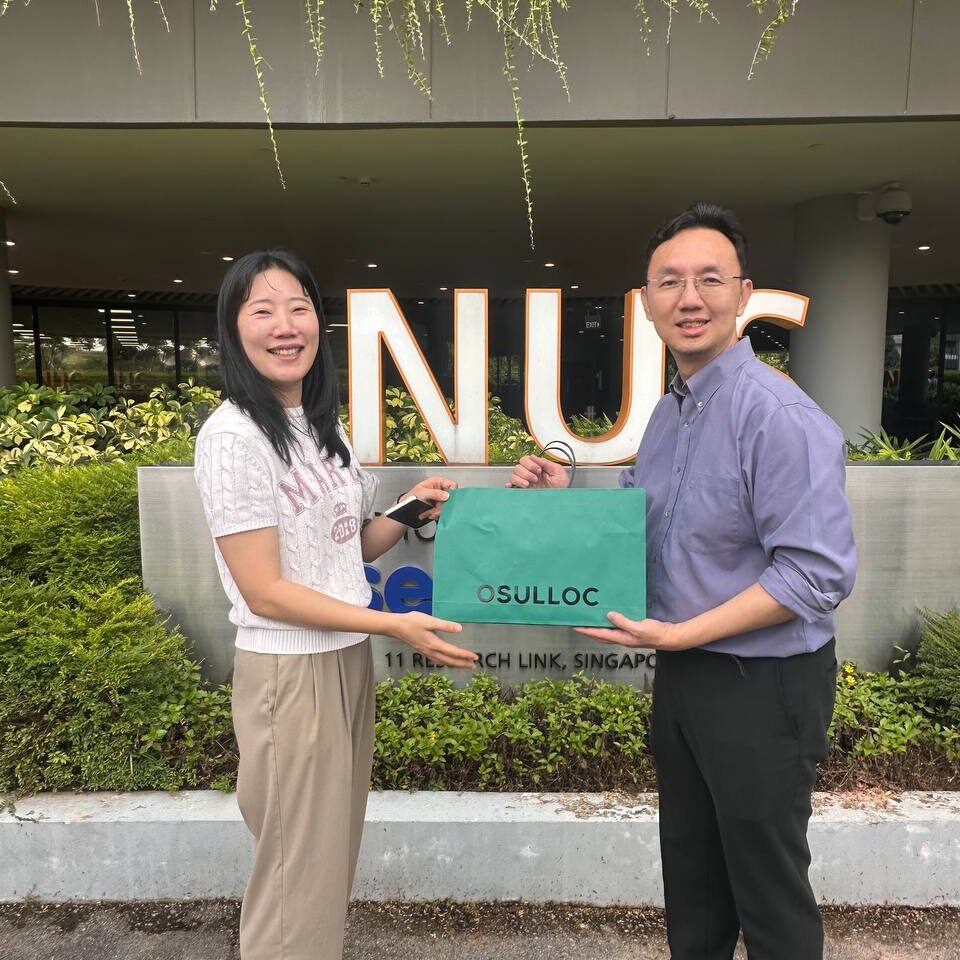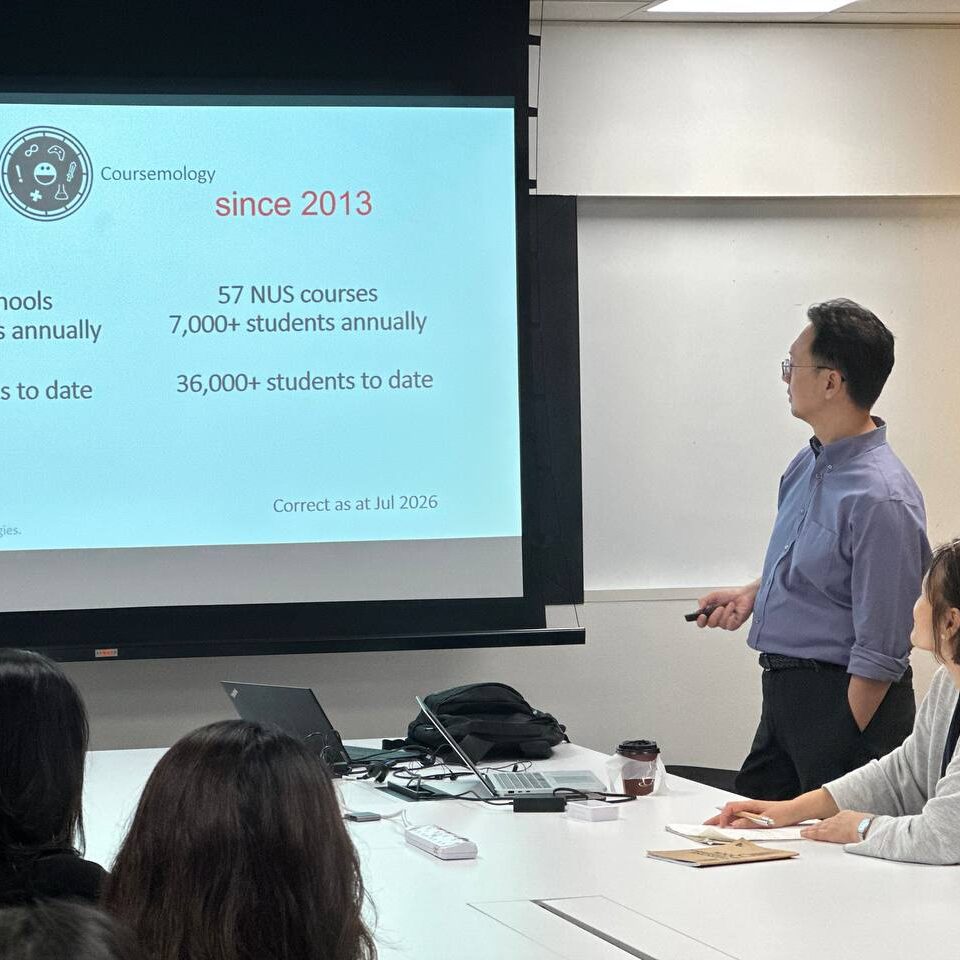
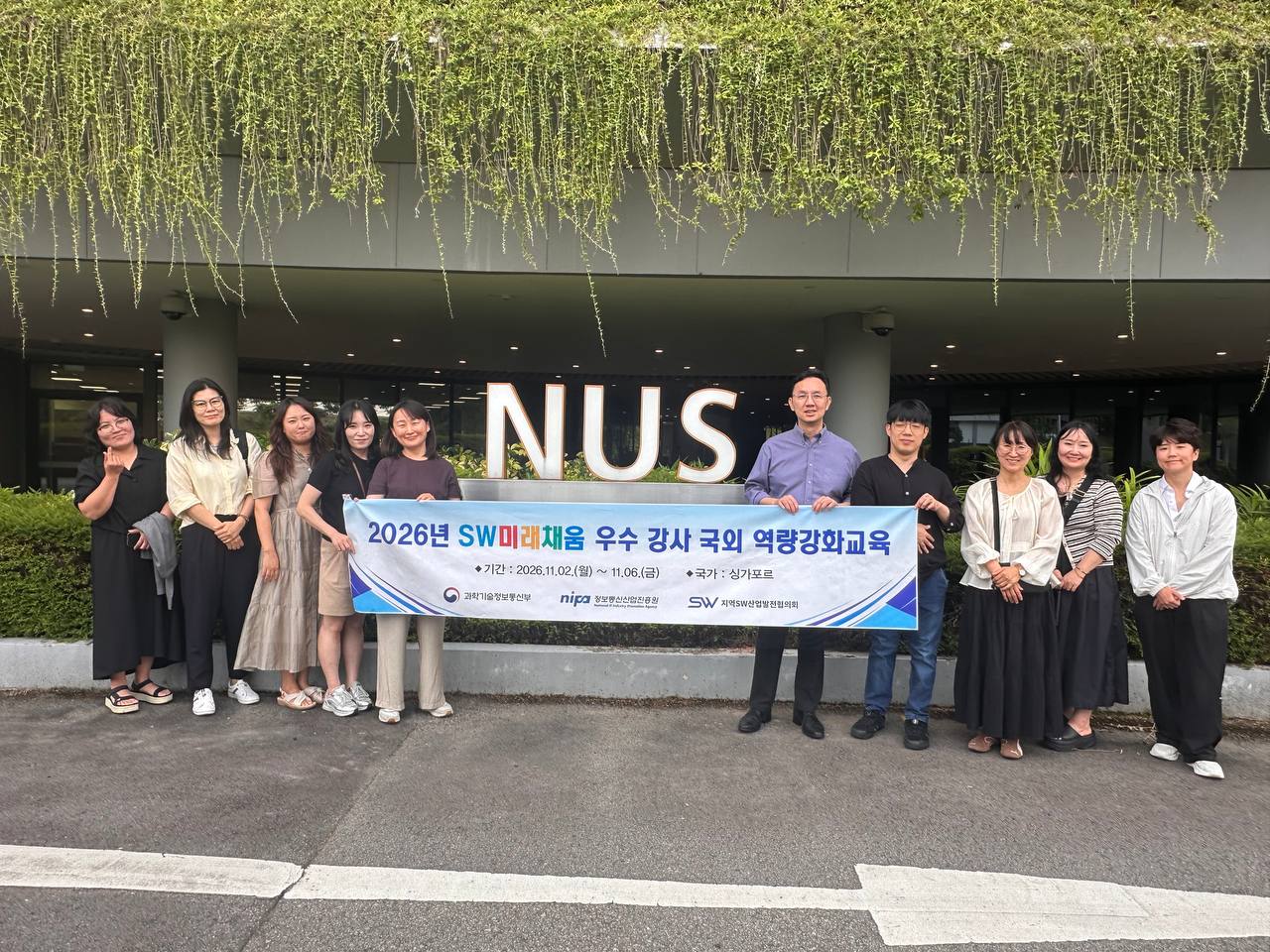
On 4 November 2026, AICET welcomed a delegation from the Korea Regional Software Industry Promotion Council (SWIPC). Hosted by Prof. Ben Leong, Director of AICET, the visit offered the delegation a look at how a university centre takes educational software from an idea in the classroom to a platform used by thousands of students across NUS and Singapore schools.
Start with the problem, not the technology
Prof. Ben began by explaining why AICET does not treat educational innovation as a technology challenge. In his view, the harder questions are about pedagogy, and the Centre’s goal is not to replace teachers but to give them tools that make them more effective, whether by improving efficiency, enabling new approaches, making experimentation easier or improving how learning is monitored.
For an audience from the software sector, he described AICET’s development process in four stages: identify a real problem or opportunity, build AI-based software to address it, iterate with actual users, and make the solution sustainable so it continues to be used after the initial project ends. Recent advances in AI, such as the ability to simulate human interaction, perform approximate reasoning, coordinate multiple agents and work across languages, have widened the range of problems this process can tackle.
He also pointed out that, in his experience, effective AI adoption is a people problem rather than a technical one. This is why AICET runs a consulting arm that has partnered NUS instructors on new uses of AI in teaching. Projects are proposed by faculty in response to a call focused on self-directed learning, and are assessed on feasibility, impact and scalability.
One problem, one platform
Rather than presenting a product catalogue, Prof. Ben walked the delegation through the specific problems behind each of AICET’s platforms.
Grading at scale. Exam marking was an obvious first target. Since 2022, SoftMark has supported grading in around 70 NUS courses and some 150 MOE classes, handling more than 100,000 scripts in each setting to date.
A shortage of computing teachers. With computer science teachers in short supply, Coursemology has helped teach programming since 2013. It is used in more than 50 NUS courses and over 30 MOE schools, reaching about 9,000 students a year, and has also been adopted by Ngee Ann Polytechnic for teaching Python. Codaveri complements it by generating automated feedback on coding questions.
Keeping learners motivated online. Describing teaching as largely a matter of managing motivation, Prof. Ben explained that online learning often falls short because students cannot sense that the teacher cares. Cikgo aims to capture these affective aspects of teaching, with applications in remedial lessons, online teaching and adult education.
Practice that is hard to provide in person. ScholAIstic, AICET’s agentic-AI learning platform, gives instructors access to 36 large language models while letting them see exactly how students use AI. It has been used for role-play in disciplines such as Social Work, Nursing and Law, and Prof. Ben showed how a coaching scenario lets trainees practise a difficult conversation with a simulated staff member before receiving AI-generated feedback. Next on the roadmap are real-time chatrooms that bring together multiple students and AI agents, with instructors able to step in, alongside voice, file uploads and document editing in a single session. Similarly, KouShi’s AI teacher LaoShi gives students live one-to-one speaking practice that teachers rarely have time to provide.
The overview also covered plagiarism detection designed for the era of large language models, AI-based interview training, and tools still in development, including online testing of coding ability and an AI tutor that offers guidance and encouragement.
Rethinking assessment for an AI-enabled world
The final part of the session turned to assessment. Prof. Ben summarised Singapore’s approach as teaching students to use and learn with AI, combining AI with other proven methods, and setting clear guardrails. Assessment, he said, should stay tied to learning outcomes, measure mastery and keep students accountable for their own learning.
He noted that misuse of AI is often a matter of self-discipline rather than ability, which is why detection alone is not enough. His suggestion to students is to hand AI the work they would rather not do, not the work they have yet to learn to do. Looking ahead, he argued that as AI takes on more routine tasks, skills such as creativity, communication and leadership will matter more, and that AI can be used to help train and assess them.
Closing
The visit concluded with a Q&A session. AICET thanks the delegation from SWIPC for their visit and looks forward to further exchanges between Singapore and Korea on the role of software and AI in education.