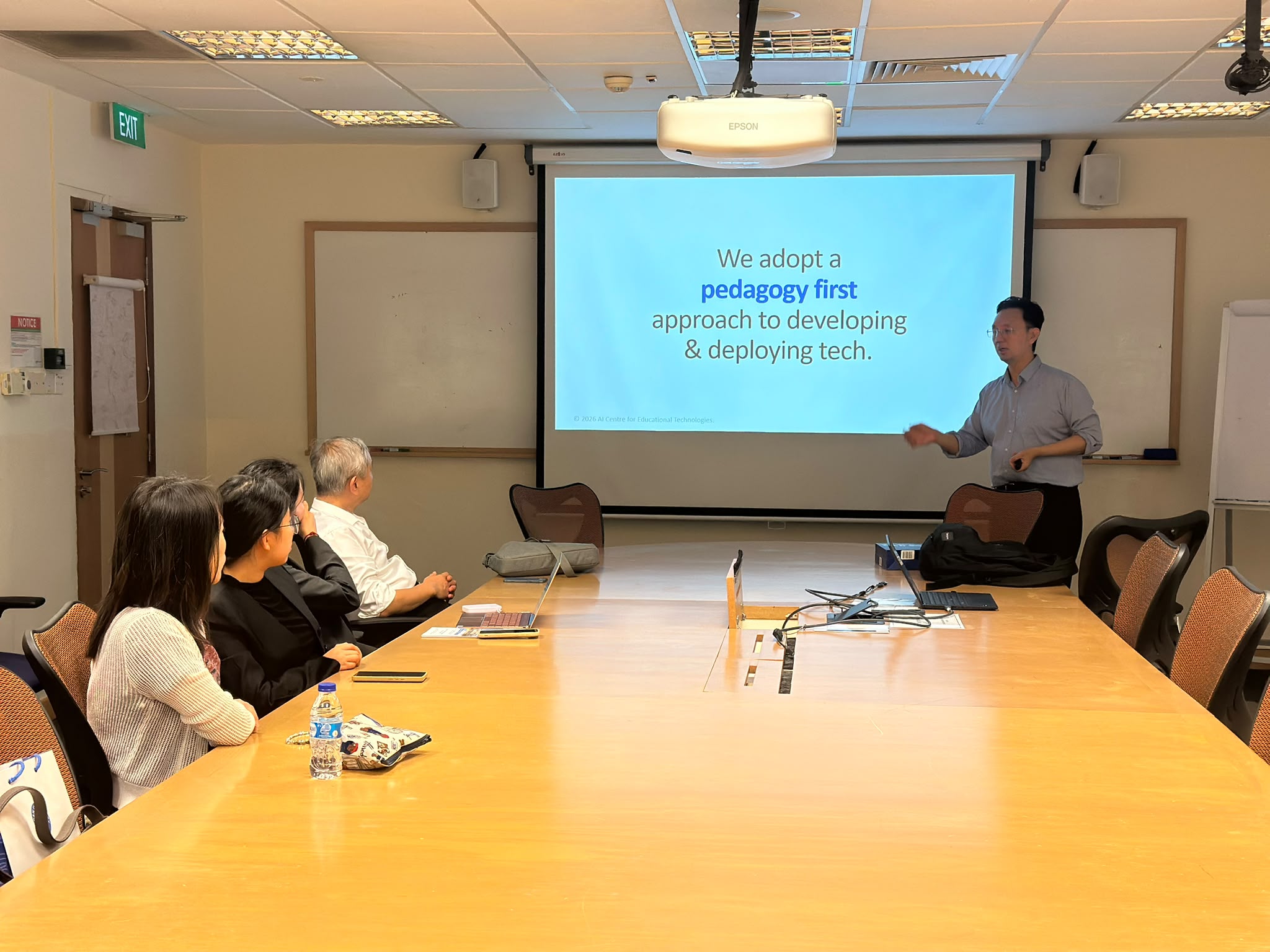
On 18 November 2026, AICET welcomed a delegation from the Center for Faculty Development at Fudan University, led by Professor Lu Fang, Director of the Center for Faculty Development. The visit was hosted by Prof. Ben Leong, Director of AICET.
A Pedagogy-First Approach
Prof. Ben opened by explaining the principle behind AICET’s work: innovation in education is a pedagogy problem more than a technology problem. The centre aims to build tools that help teachers teach better, not to replace them. He described AICET’s process of identifying pressing problems in teaching, building software to address them, then validating and refining that software with the educators who use it.
AICET’s Platforms
He gave an overview of AICET’s platforms and how each one grew out of a specific teaching need. These include tools for grading exam scripts, automated feedback on coding exercises, online coding assessments, and an AI tutor that guides and encourages students through their coursework.
He spent more time on ScholAIstic, AICET’s agentic-AI learning platform, which gives educators access to a range of large language models and lets teachers see how students interact with them. He shared examples of how faculty in disciplines such as nursing, social work and law have used AI role-play, where students practise real-world conversations with AI characters and then reflect on their performance. He also demonstrated a coaching role-play from a leadership course he is teaching, which takes students through several stages of a coaching conversation followed by AI-generated feedback.
Looking Ahead
Prof. Ben outlined the next phase of development for AICET’s platforms. This includes AI simulations in which several AI agents play different roles, real-time sessions where multiple students and instructors can join the same conversation, and support for voice and document editing alongside chat.
Lessons on AI Adoption
In his closing, Prof. Ben highlighted reflections on what AICET has learnt from working with educators. He noted that the technical problems are often the easier ones, and that effective adoption of AI depends mainly on people: helping educators and students understand when AI is useful, and which skills remain important to teach and assess.
AICET thanks Professor Lu Fang and the Fudan University delegation for the visit and looks forward to future exchanges.