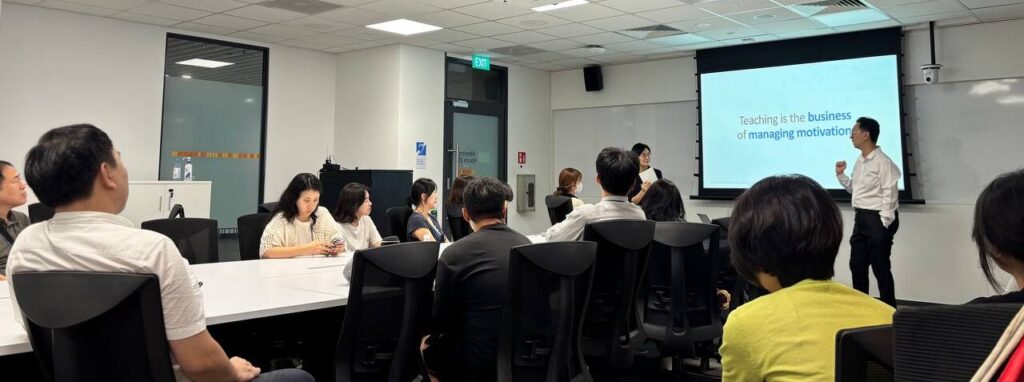
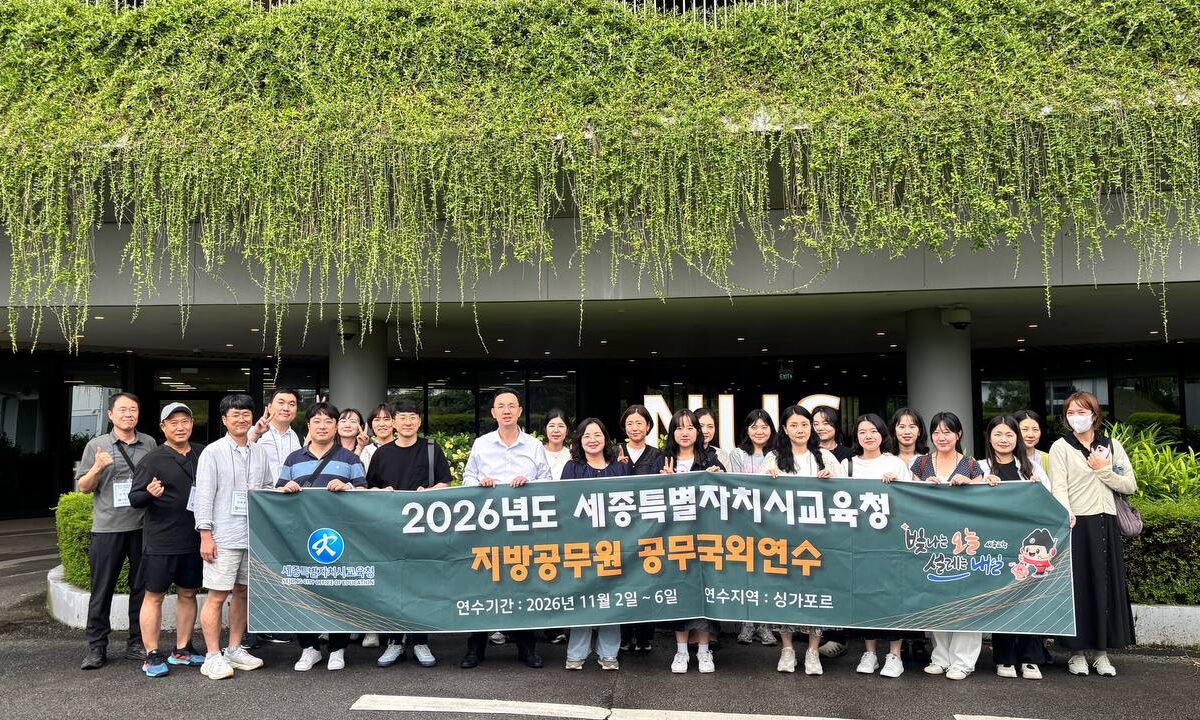
On 5 November 2026, AICET hosted a delegation from the Sejong City Office of Education. Prof. Ben Leong, Director of AICET, shared how the centre builds AI tools around the needs of teachers and how these tools are being used in Singapore schools.
From university labs to school classrooms
Prof. Ben explained that AICET’s work starts from a simple premise: AI should not replace teachers, but help them do what they already do, better.
Educational innovation, in his view, is less a technology problem than a pedagogy problem. Each platform therefore begins with a real classroom need, is built and tested with the teachers and students who use it, and is refined until it can be sustained in everyday teaching.
Several of these platforms already reach Singapore schools. SoftMark supports exam grading in around 150 MOE classes, easing one of the most time-consuming parts of a teacher’s workload. Coursemology, a gamified learning platform, is used to teach programming in more than 30 MOE schools, helping to address a shortage of computer science teachers. KouShi’s AI teacher, LaoShi, gives students live, two-way speaking practice and an actionable report afterwards, providing the one-to-one time that teachers rarely have enough of.
The delegation also saw ScholAIstic, AICET’s agentic-AI learning platform, which lets teachers see exactly how students interact with AI. Its role-play chatbots allow learners to practise realistic conversations, from a parent engagement scenario developed for MOE to a coaching exercise Prof. Ben uses in his own leadership course. As he noted, anyone can build a chatbot, but it is the pedagogy behind it that makes it useful. Upcoming features will let groups of students work with multiple AI agents in real time, with teachers able to join the conversation at any point.
Using AI wisely at every age
Prof. Ben also outlined Singapore’s approach to AI in schools: teach students to learn with AI, blend it with other approaches, and set clear guardrails. AI use should suit the learner’s age, starting with light, supervised use in primary school and moving towards independent, responsible use later on. Assessment, he added, should remain aligned with learning outcomes, measure mastery and keep students responsible for their own learning.
On academic integrity, Prof. Ben observed that misuse of AI is usually a matter of self-discipline rather than ability. His advice to students was to use AI for tasks they do not want to do, not for tasks they cannot yet do. As AI takes over more routine work, he suggested that schools give greater weight to human skills such as creativity, communication and leadership, which AI itself can help to train and assess.
The visit ended with a Q&A session. AICET thanks the Sejong City Office of Education for their visit and looks forward to future exchanges.