On 18 November 2026, AICET's Pedagogy Team took part in the AI for Education Conference (AIFE 2026), organised by the National Institute of Education (NIE) at Nanyang Technological University (NTU). Held from 16 to 18 November under the theme Pedagogical, Inclusive, and Ethical Use of AI in Education, the conference brought together researchers, educators, policymakers and industry partners from Singapore and abroad.
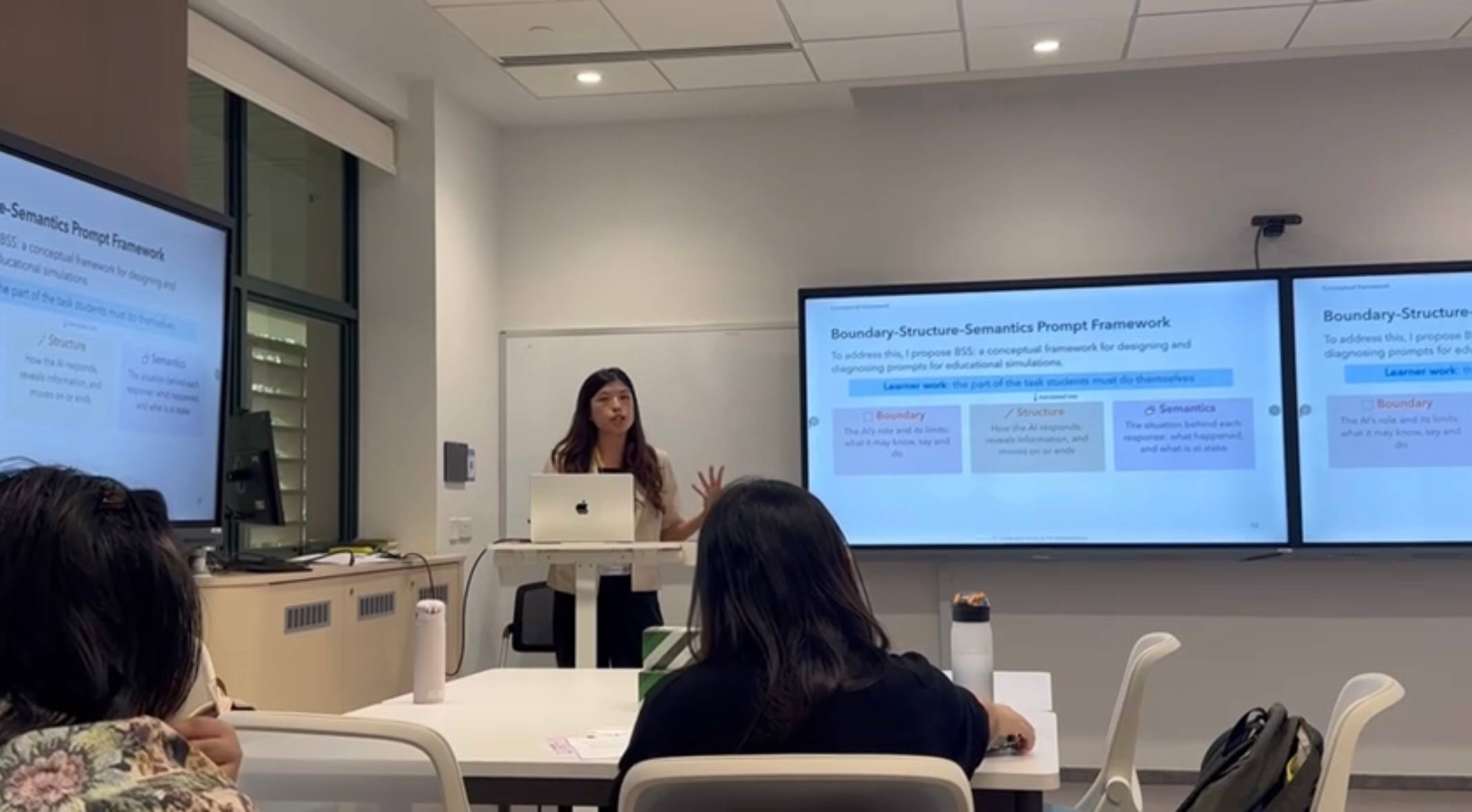
Karina Yuen, EdTech Development Specialist at AICET, delivered two presentations on AI simulations: one examining how prompts can be designed to preserve the intended learning task, and another sharing preliminary findings from an MBA finance assignment developed with NUS Business School.
A prompt framework for AI simulations
In her first talk, "Designing LLM-Based Educational Simulations to Preserve the Learning Task: A Boundary–Structure–Semantics Prompt Framework", Karina looked at a common problem in AI role-play: a chatbot can sound natural and still fail to give students the practice they need. Large language models tend to be too helpful, giving away information or resolving tension too soon. Because they have no lived experience of the situation, they also fill gaps in a prompt with generic guesses that do not fit the case.
From her work on medicine and leadership simulations for NUS courses, Karina proposed the Boundary–Structure–Semantics (BSS) framework for writing and diagnosing simulation prompts. It breaks prompt design into three parts: Boundary covers what the AI may know, say and do; Structure sets when it reveals information, moves on or ends; and Semantics provides the case details, motives and stakes behind its replies.
Karina noted that BSS is a conceptual framework rather than a validated procedure, and that prompts can steer model behaviour but not fully control it. Future work includes testing the framework across models and tasks, and building a reusable tool to help instructors draft and review prompts.
AI executive interviews in an MBA finance course
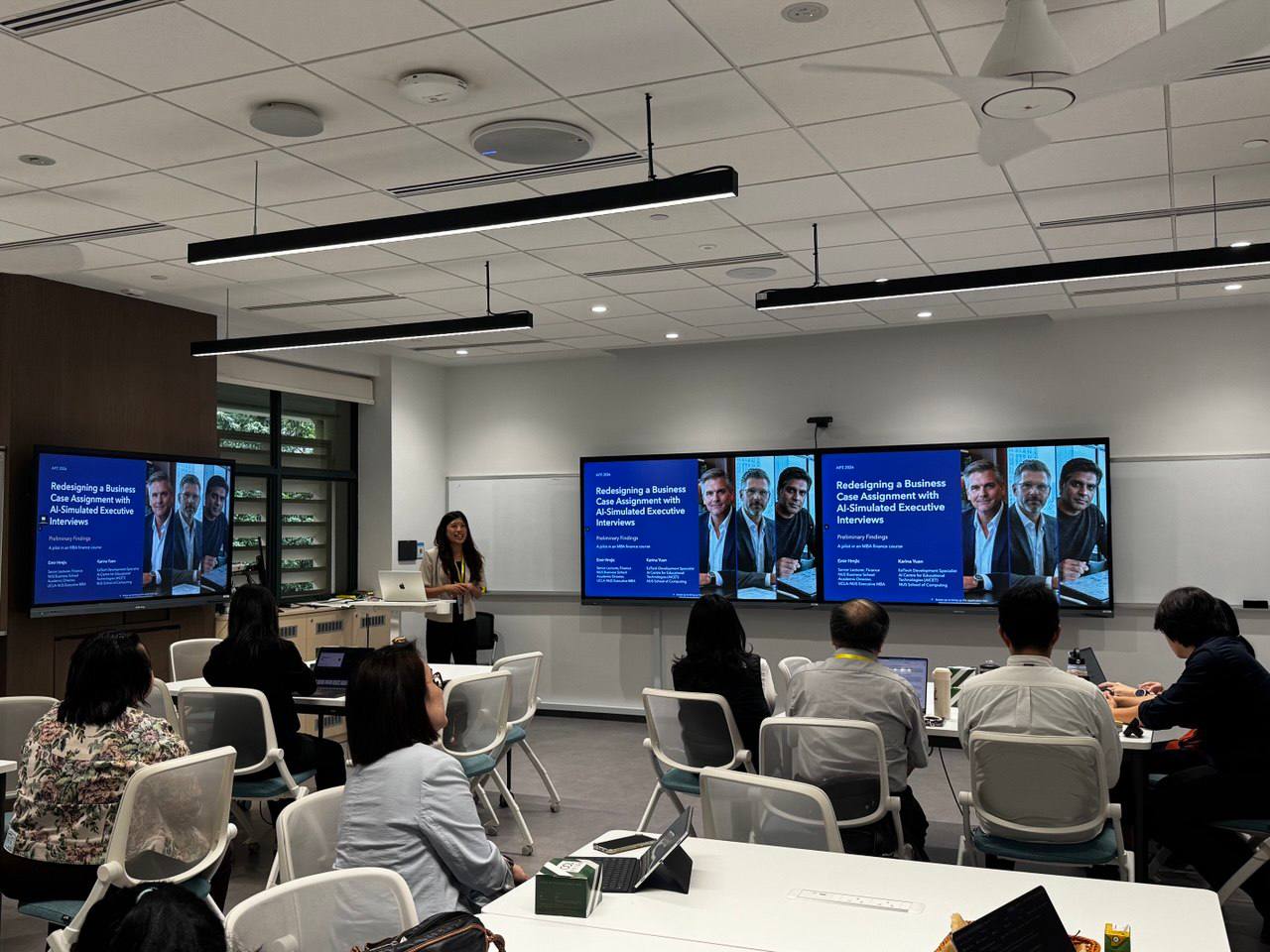
In her second talk, "Redesigning a Business Case Assignment with AI-Simulated Executive Interviews: Preliminary Findings", she presented a project developed with Dr Emir Hrnjic, Senior Lecturer in Finance at NUS Business School and Academic Director of the UCLA–NUS Executive MBA.
In a part-time MBA finance course, students normally analyse a written case summary to prepare an IPO pitch. Built on ScholAIstic, AICET’s platform for AI learning activities, the redesigned assignment replaced that summary with interviews with three AI executives: a CEO, a CFO and a Chief Product and Technology Officer. All three drew on the same anonymised prospectus of a real company, but each had a different role and view of the business. Students had to decide whom to ask, weigh differing accounts and review automated feedback after each interview.
Of the 40 students in the March 2026 pilot, 38 completed all three interviews. Among the 35 with matched surveys, 89% said they adjusted their approach after earlier feedback, 91% said interviewing the executives separately helped them see differing perspectives, and 91% would recommend the simulation. Students felt significantly more prepared to interview company management, while their comfort in probing vague answers and overall confidence did not change significantly.
The activity has since been used in MBA and Executive MBA courses with an added AI senior banker to help students plan and review their interviews. Next, the team plans to study how students follow up on executives’ answers and use the feedback in their final pitches.
Looking ahead
The two presentations reflect complementary sides of AICET’s work on AI simulations: designing interactions that keep students doing the core learning work, and evaluating how they use these activities in real courses. AICET will continue working with NUS faculty to build and refine AI-supported learning activities across disciplines.