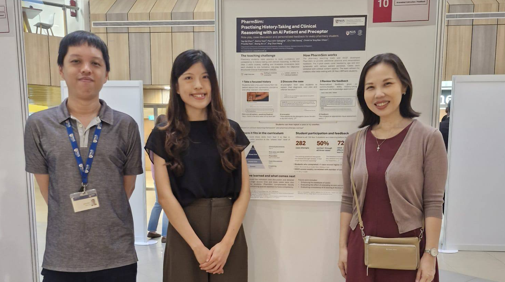
On 17 November 2026, AICET joined colleagues from across NUS at AIED Poster Showcase – Practices and Possibilities, hosted by the Centre for Teaching, Learning and Technology (CTLT).
The showcase brought together 13 posters on how AI is being applied in teaching and learning, organised around two themes: AI Literacy & Fluency, on building students' capacity to understand, evaluate and use AI, and Teach & Transform, on educators redesigning pedagogy, assessment and learning through AI.
Pedagogy EdTech Development Specialist Karina Yuen represented AICET at the event. Two of the posters on display featured projects developed with AICET's involvement, from the Department of Pharmacy and Pharmaceutical Sciences and the Alice Lee Centre for Nursing Studies.
PharmSim: practising history-taking with an AI patient and preceptor
PharmSim was developed by the pharmacy teaching team and AICET to give pharmacy students more practice in history-taking and clinical reasoning. In PR3150, a Year 3 skills course, large class sizes and staffing constraints meant each student had only one formative role-play before the Objective Structured Clinical Examination (OSCE).
Built on ScholAIstic, AICET's platform for AI role-play, PharmSim takes students through three stages. They first take a focused history from an AI patient, then explain their diagnosis, care plan and referral decision to an AI preceptor, and finally receive personalised feedback on their communication, history-taking approach and knowledge application. Students can then repeat a case or try another.
See how PharmSim works in this video walkthrough.
The three pilot cases cover headache, eye and skin symptoms, with a range of patient personas. Cases were validated with clinical content experts, and the chatbots were refined after beta-testing with 20 Year 4 BPharm students.
PharmSim was offered to all 139 Year 3 students as e-learning ahead of the OSCE. Students made 282 case attempts, half worked through all three cases, and 72% rated it a highly effective revision tool. Students who completed at least one case scored higher in the OSCE than those who did not, though the correlation between number of cases completed and OSCE score was weak.
Students valued the individual case discussion and detailed feedback, and asked for longer access and more cases. Next steps include expanding the case database, evaluating the effect of a longer access period, and assessing the consistency of AI scoring and feedback.
INSPIRE-AI: a virtual teaching assistant for nursing honours research
The second poster presented INSPIRE-AI, an AI-facilitated virtual teaching assistant for final-year nursing students undertaking honours research in NUR4104B/C. The team set out to develop the tool and evaluate its effect on students' research self-efficacy, motivation and interest.
INSPIRE-AI works within a single chat in two modes: a structured curriculum mode that guides students through sequenced research learning activities, and an on-demand mode for questions about their own thesis projects. Its responses are grounded in curated undergraduate-level academic materials, and its design draws on Vygotsky's Zone of Proximal Development, Bloom's taxonomy and the load reduction instruction framework.
Of 146 students, 76 completed the baseline survey and 70 the post-intervention survey, and 16 were interviewed. Students showed a statistically significant increase in research self-efficacy, while research motivation, interest and academic anxiety did not change significantly. Interviews suggested that students' uptake was shaped by uncertainty about the tool's scope and legitimacy, and by the wider honours support environment.
The team concluded that successful implementation depends on clear guidance on appropriate AI use, transparent governance on data access and monitoring, and open communication that supports students' psychological safety.
Looking ahead
Though rooted in different disciplines, both projects used AI to give students more individual practice and support than limited staff time would otherwise allow, and both were evaluated with students in real courses. AICET thanks CTLT for organising the showcase and looks forward to continuing its work with faculty partners across NUS.