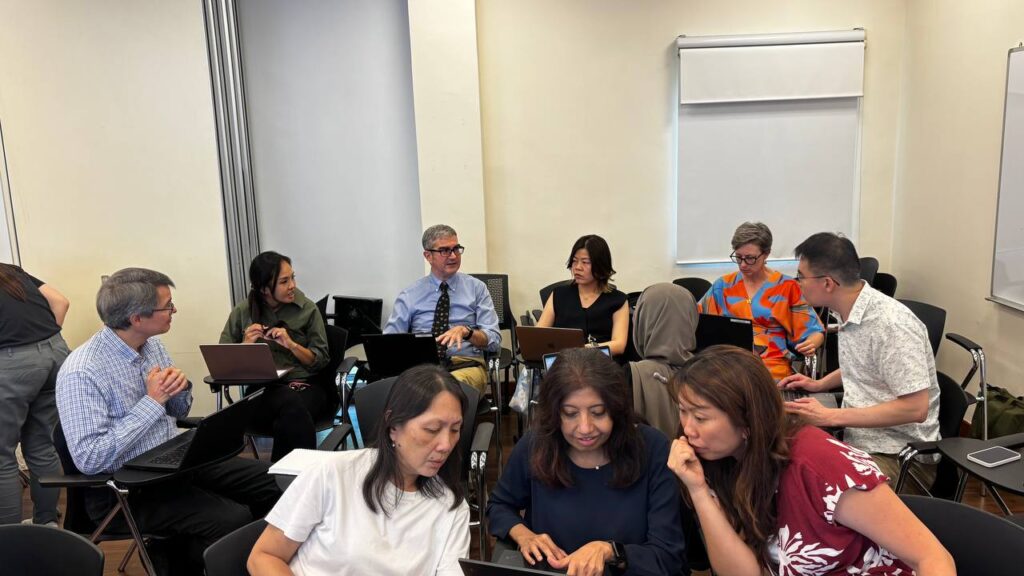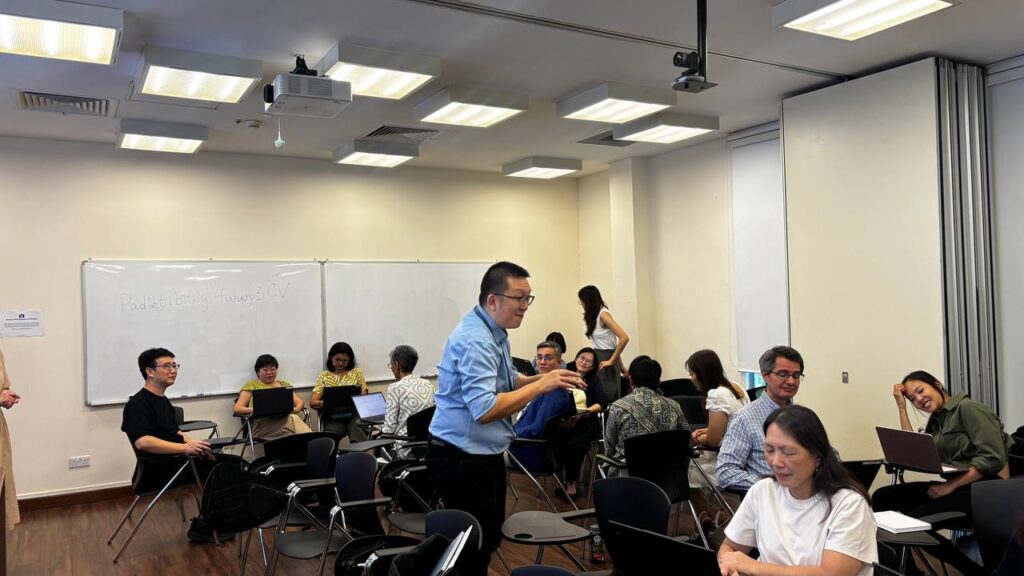
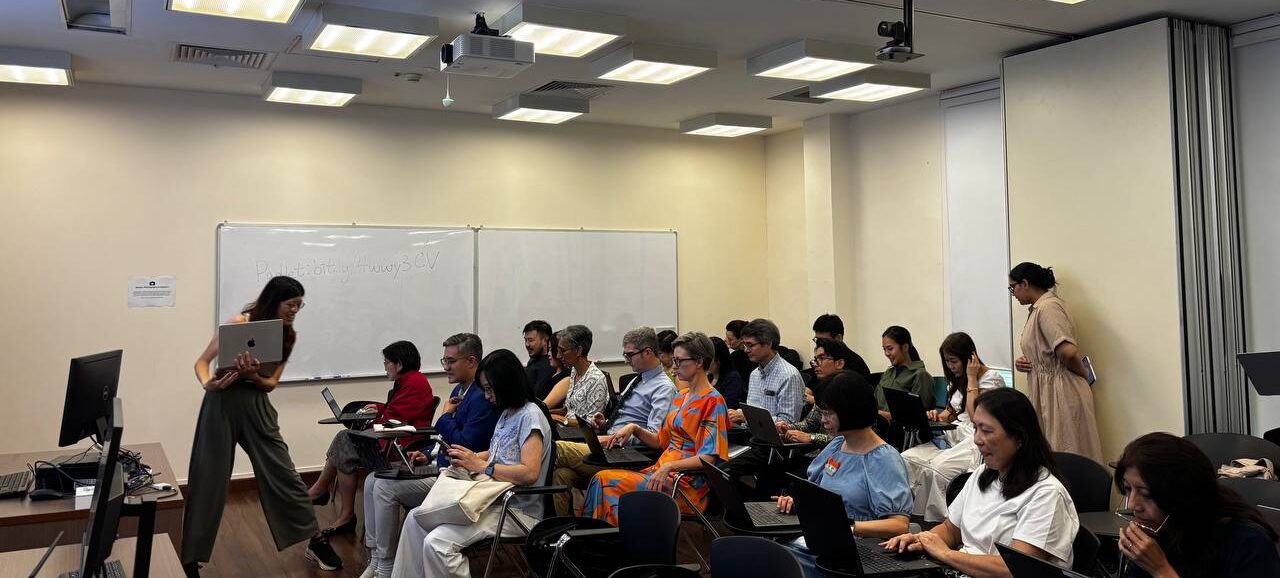
On 5 August 2026, AICET conducted a hands-on workshop introducing ScholAIstic to faculty from the Centre for English Language Communication (CELC). The session was led by Prof. Soo Yuen Jien, AICET’s Deputy Director (Pedagogy and Research), with support from AICET EdTech Specialists Bernice Loon, Geraldine Tan, Karina Yuen, and Pragya Chandel, and was customised specifically for CELC’s teaching context, building on AICET’s broader collaboration with the Centre for Teaching and Learning Technologies (CTLT) on ScholAIstic workshops.
Learning ScholAIstic as a Student First
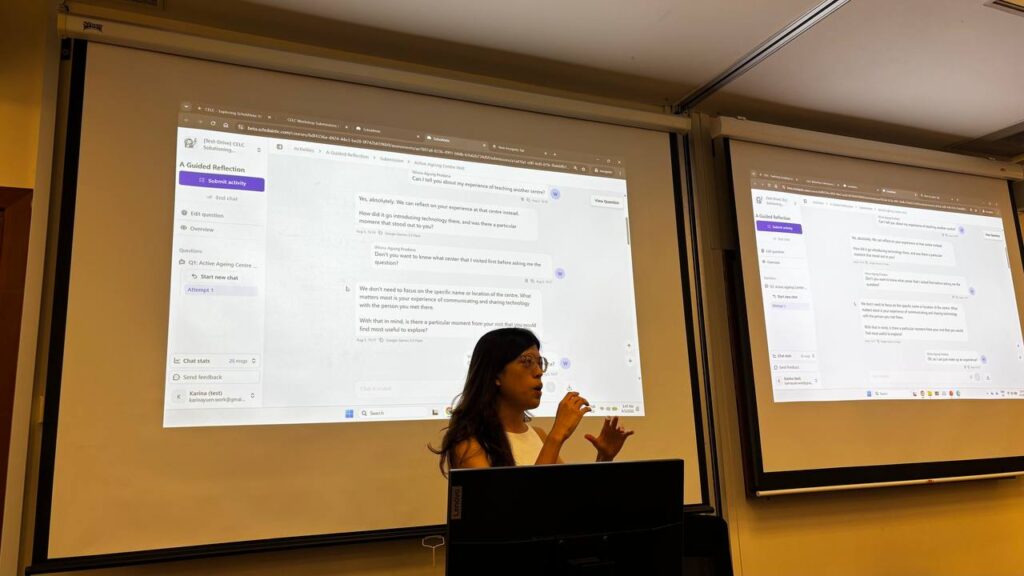
During the session, participants were given the opportunity to test-drive ScholAIstic themselves, experiencing first-hand four sample activities built on the platform: practicing answers to interview questions, reflecting on a past communication experience, practicing informal conversations, and revising a scientific explanation based on feedback. Walking through these as students first gave faculty a concrete sense of what ScholAIstic-based activities feel like in practice, before designing their own.
Designing an Activity: From Teaching Problem to AI Prompt
This segment was led by Karina, who unpacked how each activity had been designed, starting from the same questions instructors would ask for any learning activity: what should students learn or practice, what should they do during the activity, and what feedback should they receive. In ScholAIstic, these decisions translate into two prompts — a chatbot prompt that shapes the interaction itself, and an evaluation prompt that assesses it afterwards. Instructors were also shown what they, as teachers, are able to see on the platform: each student’s individual attempt, the full conversation, the number of conversational turns, and the feedback shown to the student at the end.
From Concept to Prototype
With the mechanics established, participants were guided to identify a teaching problem from their own practice and map it to a suitable use case. Working in groups, faculty adapted one of the sample activities to fit their own teaching context, testing and refining it along the way. The session closed with an opportunity for participants to share their prototypes with one another, followed by a planning segment on next steps for piloting activities in actual CELC courses.
What’s Next
Participants were pointed to several ways to continue building on the session, including further joint AICET-CTLT workshops, ongoing support to keep refining their prototypes, and avenues to formalise their ideas for eventual deployment in their courses. The workshop gave CELC faculty a practical, guided introduction to designing their own AI-supported learning activities on ScholAIstic, grounded in real teaching problems rather than the technology itself.