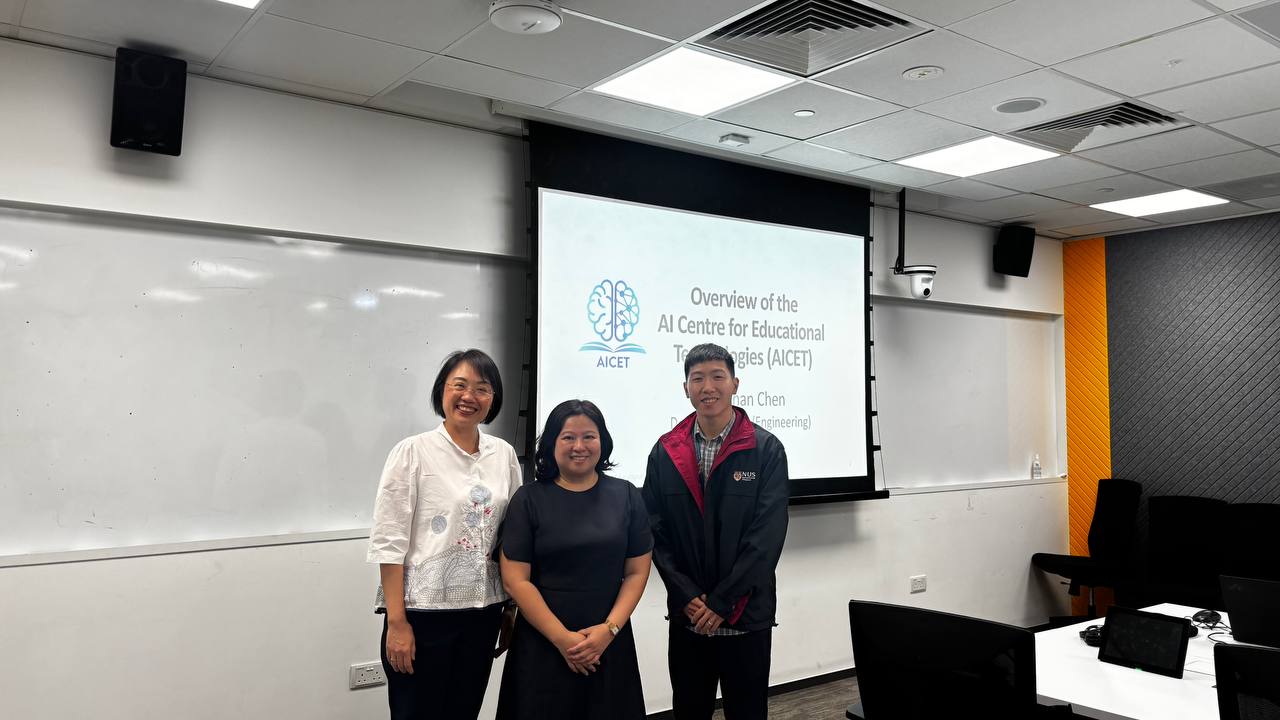
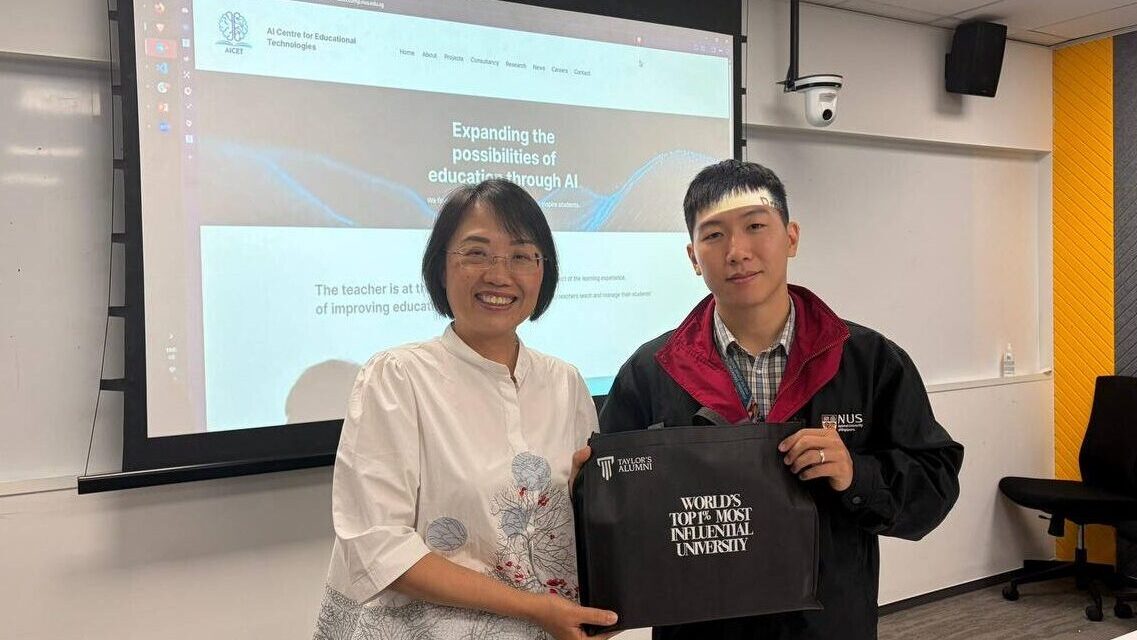
On 25 June 2026, AICET welcomed a delegation of academic leaders from Taylor’s University Malaysia, including Assoc. Prof. Dr. Lydia Foong Yoke Yean, Director of Curriculum and Education Development, and Dr. Yoon Sook Jhee, Expert in Academic Policy and Curriculum. Hosted by Jonathan Chen, AICET’s Deputy Director (Engineering), the visit served as a vibrant platform for exchanging pedagogy insights and exploring how artificial intelligence is transforming the landscape of modern education.
Reaffirming the ‘Pedagogy First‘ Philosophy
The session opened with an overview of AICET’s foundational mission, drawing parallels to its vision of operating as a “Xerox PARC” for educational innovation. Established in 2020, AICET has consistently positioned itself at the intersection of advanced technology and educational practice.
During the presentation, Jonathan emphasized that at the heart of AICET’s work is a strict “pedagogy first” philosophy. In an era saturated with generic AI applications, AICET firmly believes that technology should serve as a powerful “sidekick” to the instructor rather than a replacement. Every tool developed within the center is born out of genuine classroom challenges and instructional needs, aiming to amplify the teacher’s impact and scale high-quality education globally.
Exchange of Insights using Rubric-Based AI Grading
A significant highlight of the exchange focused on Coursemology, AICET’s gamified Learning Management System (LMS). The teams discussed the platform’s latest breakthroughs in handling Short Answer Questions (SAQ) through rubric-based AI grading.
Unlike standard large language model (LLM) evaluations that often provide generic, unstructured feedback, Coursemology leverages instructor-defined, multi-criteria rubrics. This ensures that the AI evaluates student submissions with the same rigorous parameters a human grader would use.
Furthermore, Jonathan shared insights into Coursemology’s innovative “AI Playground”. This dedicated environment allows educators to iterate, test, and refine their prompts and rubrics on sample student answers before deploying them live. By offering version control and a sandbox for prompt engineering, the platform empowers teachers to calibrate the AI’s feedback loop safely, ensuring high alignment with learning objectives and synthesizing highly actionable feedback for students.
Charting the Research Frontier: Cognitive Shifts and Neural Mapping
The conversation then turned to AICET’s broader research efforts, which focus on understanding how students engage with and learn alongside AI tools. Rather than looking only at how AI can be deployed in classrooms, the discussion explored the ways in which AI is shaping student behaviour, decision-making, and learning processes.
Jonathan shared insights from ongoing studies that have uncovered several important trends. One area of research examines how students verify information generated by AI. While many students believe they are carefully checking AI-generated responses, their actual behaviour often suggests otherwise as they become more familiar with these tools.
Another study explores how students seek help from AI, finding that students who approach AI with more thoughtful and specific questions tend to gain more from the interaction. These findings underscore the importance of helping students develop critical thinking, self-reflection, and effective AI literacy skills as AI becomes increasingly integrated into education.
A Shared Vision for Higher Education
By bridging cutting-edge engineering with deeply researched pedagogy, the collaboration between regional neighbors highlights a collective commitment to shaping an educational future where technology elevates human potential.