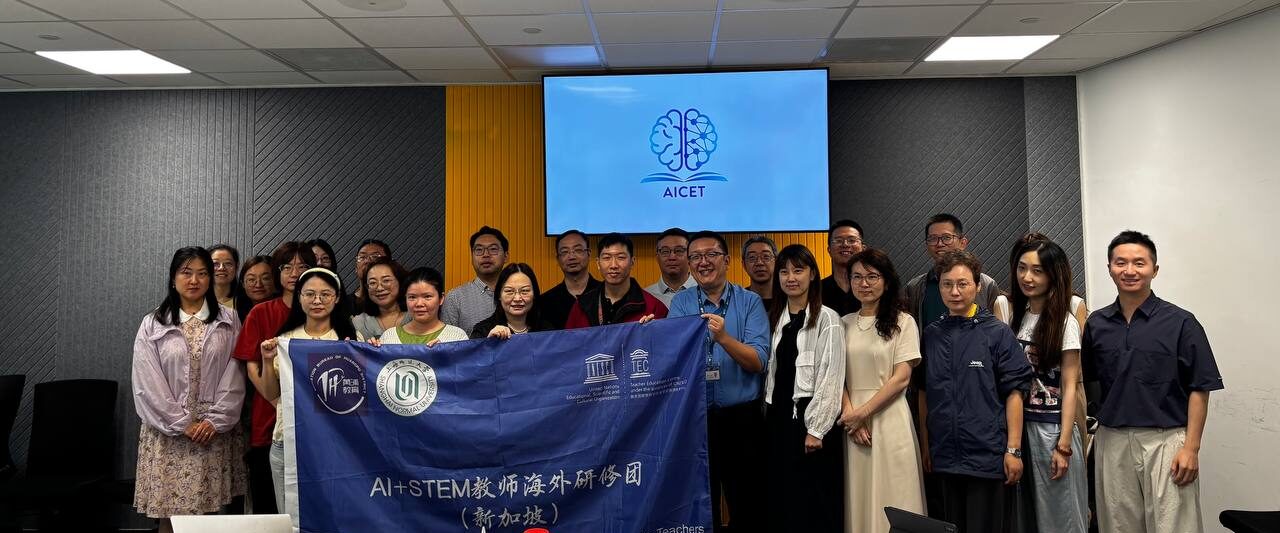
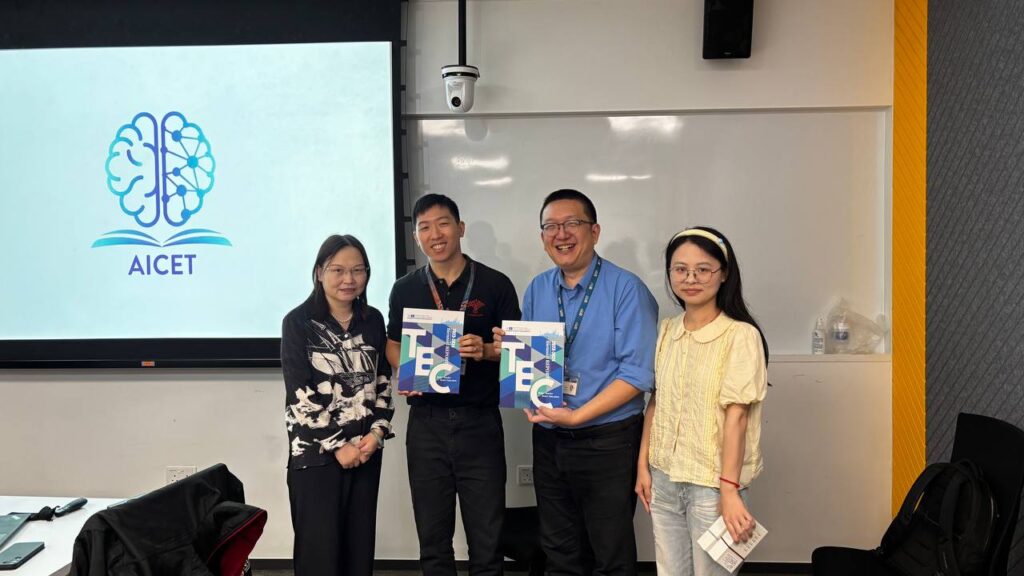
On 27 July 2026, AICET welcomed a delegation of 26 educators and programme staff from Shanghai, China, comprising STEM teachers from schools across the city alongside programme assistants and experts from Shanghai Normal University, East China Normal University, and UNESCO TEC.
The delegation brought together teachers spanning a wide range of subjects — including Science, Mathematics, Information Technology, Computer Applications, English, and Technology & Engineering — drawn from primary, secondary, and high schools across Shanghai. The visit was co-hosted by Prof. Soo Yuen Jien, AICET’s Deputy Director (Pedagogy), and Jonathan Chen, AICET’s Deputy Director (Engineering).
Reimagining Education and Disciplines with Generative AI
Prof. Soo opened the session framing AICET’s approach around two complementary tracks: “Use AI”, which focuses on building educators’ comfort and fluency with AI tools in their teaching practice, and “X+AI”, which explores how generative AI is reshaping individual disciplines themselves.
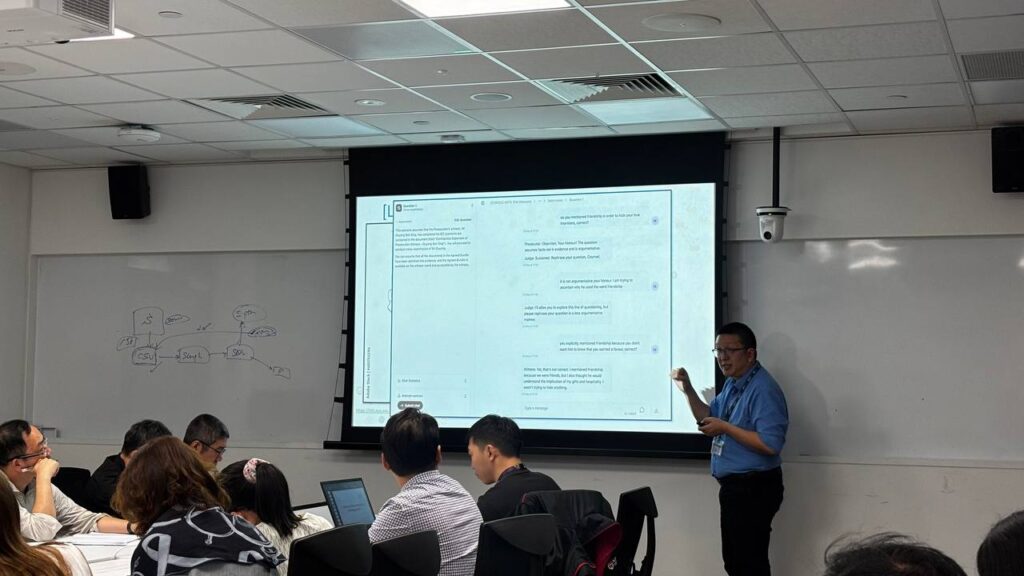
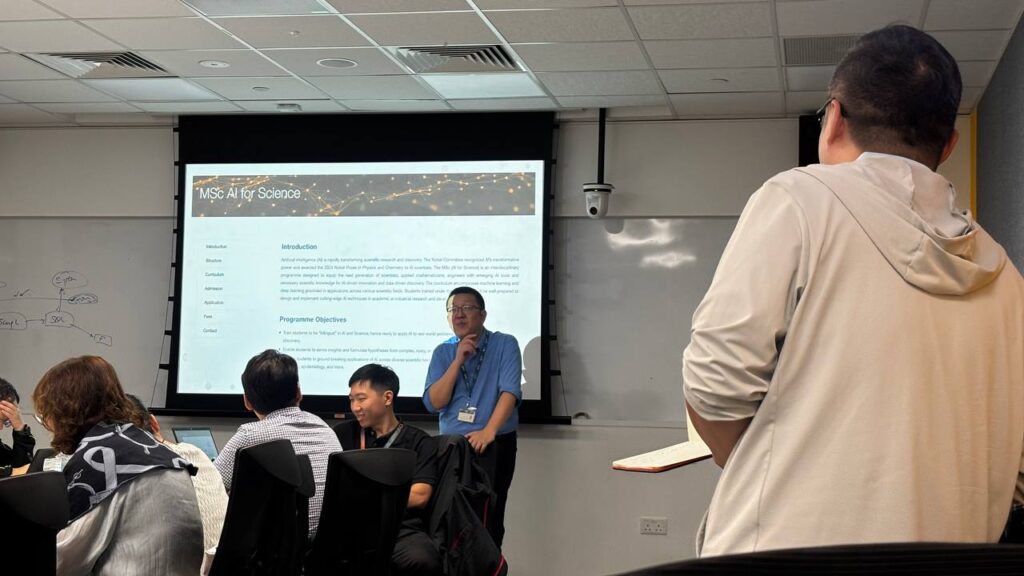
On the “Use AI” track, Prof. Soo shared a simple design framework for thinking about how AI should support a task — whether it should merely make an existing process better, actively co-create it alongside a human, or take over the task entirely — and illustrated this with real examples from NUS classrooms, including a Physics module where students learn scientific inquiry by trying to “convince” a chatbot, a Law module using AI for trial advocacy practice, and an Engineering module exploring scientific concepts through an AI art hackathon.
On the “X+AI” track, he walked through how generative AI is beginning to reshape individual disciplines: from AlphaFold’s impact on biology and pharmacy, to the emergence of machine-assisted mathematical proofs, to AI-driven personalisation and data mining in marketing, to new approaches in digital history.
Building AI Tools Around Real Teaching Problems
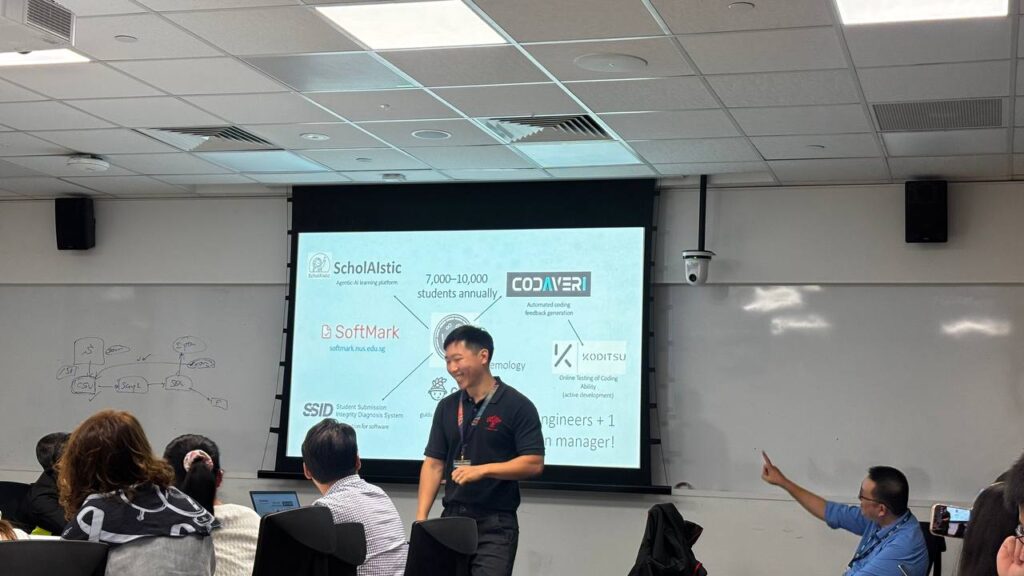
Jonathan followed with a walkthrough of AICET’s engineering approach, built around a simple sequence: identify real pain points, build software to address them, and validate and iterate with actual users.
He shared how this approach shaped several of AICET’s flagship tools:
- Coursemology: Supports ~2,000 students across 37 MOE schools and ~8,200 students across 57 NUS courses annually, offering built-in automated coding feedback and plagiarism detection.
- Codaveri: Designed to address the CS teacher shortage, it provides automated coding feedback and has graded tens of thousands of exam scripts across ~100 MOE subjects and 70 NUS courses since 2022.
- Koditsu: AICET’s assessment platform used for coding tests, practical exams, and both live and automated interviews.
- KouShi: AICET’s newly launched AI Chinese oral examination platform, as another example of tools built around a clearly identified pain point — in this case, giving students more frequent, realistic opportunities to practice spoken Chinese ahead of oral exams.
Jonathan presented several AI chatbots co-created with NUS faculties (Social Work, Nursing, Law, and CTLT) for role-play and guided practice—such as an MOE parent simulation and a GROW-model (Goal, Reality, Options, Will) coaching bot for tough workplace conversations.
The participants also tried out a hands-on live session on ScholAIstic platform in a simple science lesson activity. The participants were impressed at the capabilities of the platform, including platform analytics, voice-enabled technology, as well as the automatic feedback provided for learners.
From AICET’s work with automated feedback, he shared key takeaways:
- Effective deployment requires a human-in-the-loop approach
- AI thrives on tightly scoped questions
- 3. Rubrics need continuous tweaking to catch edge cases
The visit gave the Shanghai delegation an in-depth look at how AICET combines pedagogical research with engineering practice to develop AI tools for real classroom needs. Beyond showcasing these platforms, it fostered a valuable exchange between Singapore and Shanghai educators on their shared journey toward integrating AI meaningfully into teaching and learning.