
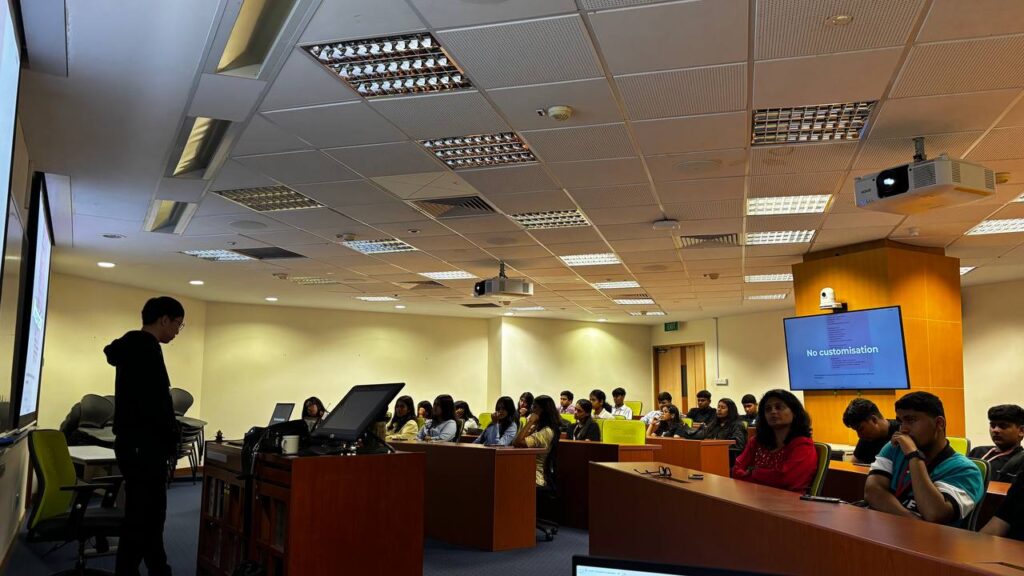
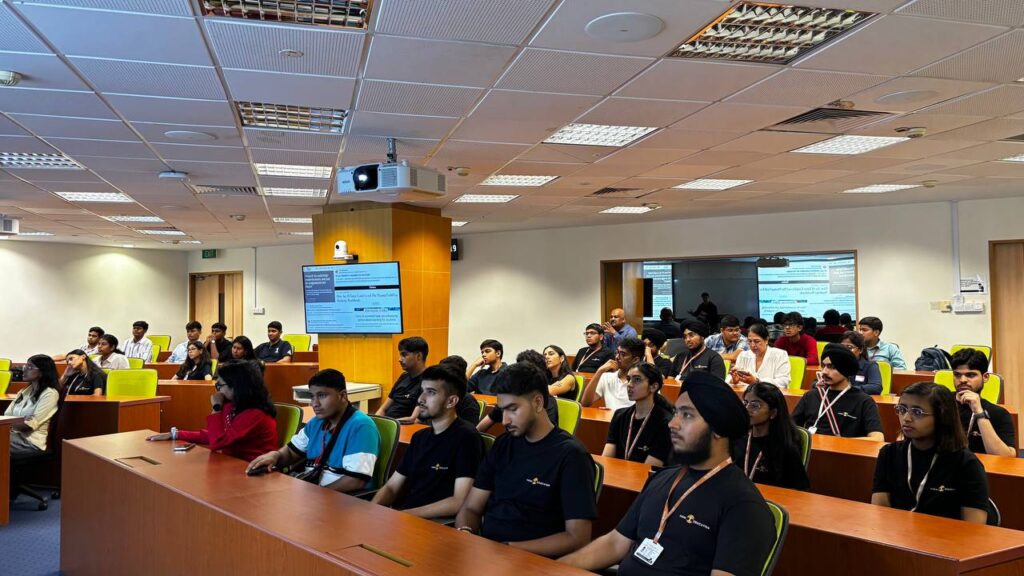
On 12 June 2026, AICET opened its doors to a vibrant group of high school students visiting from India. The cohort brought together bright minds from a diverse group of institutions including – Vasal Education Group of Schools and Shree Vallabh Ashram Group of Schools.
Led by Jonathan Chen, Deputy Director (Engineering) at AICET, the visit provided students with an inside look into how AI is transforming the educational landscape, while sparking critical conversation on how they can prepare for an AI-driven world.
Redefining Education: From Memorization to Mindset
The session kicked off posing a fundamental question: Can AI really help students learn better?
With global projections showing a 23% labor-market churn by 2027 — where millions of roles will disappear while entirely new ones emerge— the core skills required for the future are rapidly shifting toward analytical and creative thinking. Drawing insights from cognitive science and tech leaders like Demis Hassabis (CEO of Google DeepMind), the presentation emphasized that ‘learning to learn’ is the most critical skill for the next generation. Instead of focusing on storing abstract knowledge, the future of education lies in adaptive learning and solving real-world problems.
The Pitfalls of ‘Outsourcing Cognition’
While AI-powered personal tutors promise 1:1 personalization, the session also raised vital warnings about over-relying on tech. Relying on AI to write essays or solve problems without building foundational knowledge can lead to cognitive offloading and erode critical thinking. Using the ‘Memory Paradox’ and the concept of cognitive mastery, Jonathan illustrated how true expertise — like that of a veteran hawker cook — requires repetition and deep domain knowledge to train quick-thinking and intuitive understanding. Without internal domain expertise, we lose our ‘error detectors’, making us vulnerable to AI hallucinations and misinformation.
The AICET Approach: Pedagogy First, Technology Second
Students were introduced to AICET’s suite of specialized educational platforms, and introduced to AICET’s core philosophy: Innovation in education is not a technology problem; it’s a pedagogy problem. Technology does not replace sound teaching methods, it scales and strengthens them. The students caught a glimpse of how AICET builds multi-agentic AI systems to tackle real teaching challenges — ranging from rubric-guided automated feedback systems to parent engagement role-playing chatbots that train educators in empathy, communication, and human skills.
A Future Built on Human Skills and Values
As the session came to a close, the core message left with the students was one of balance. While AI will make producing end-products easier, the skills that will truly matter in the future are uniquely human.
Mirroring AICET’s vision of becoming a ‘Xerox PARC in education’, the center emphasized its social responsibility to ensure technology never eclipses character education. Ultimately, education remains a deeply human endeavor focused on values and heart.
AICET was thrilled to host these future leaders from India, inspiring them to ask the right questions and intentionally develop the human skills needed to bridge the AI gap.