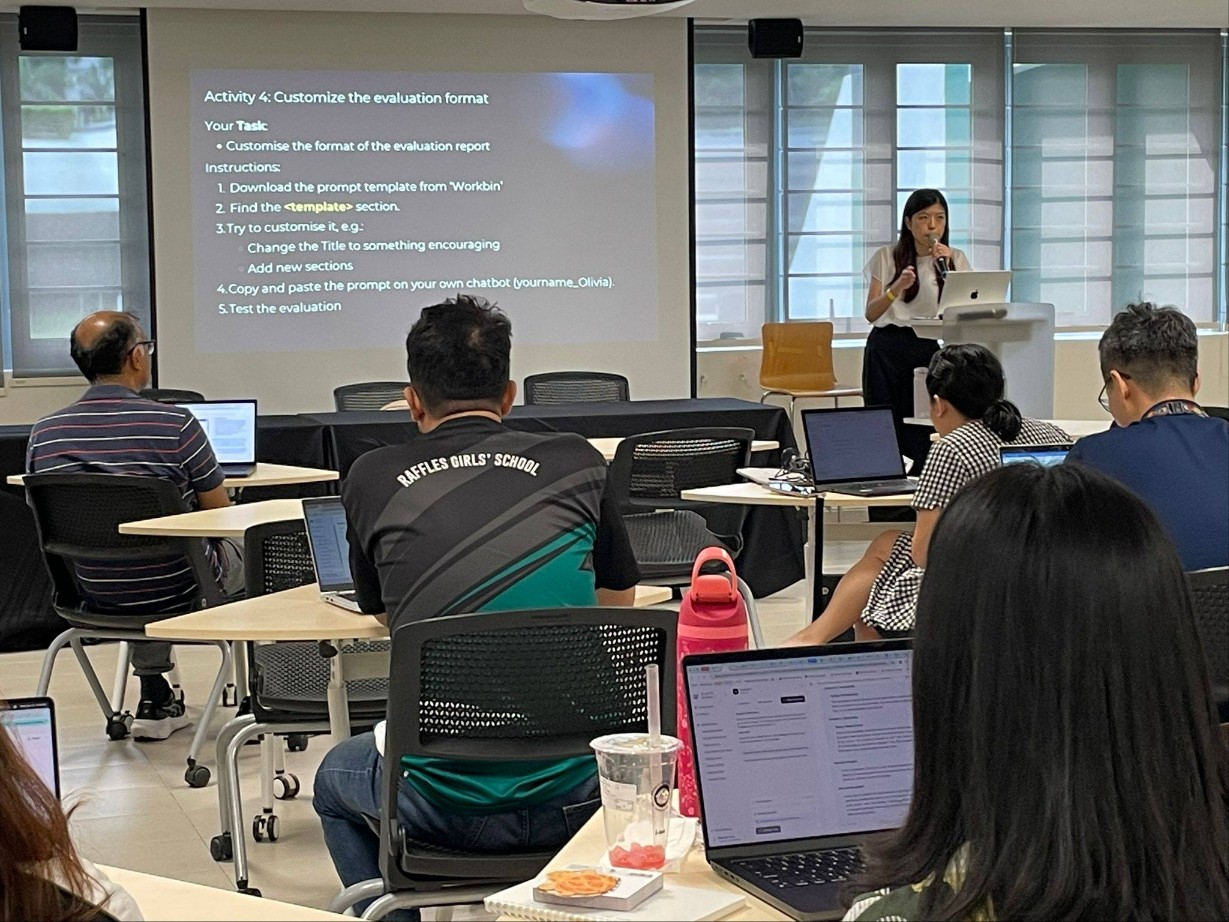
On 21 January 2026, a group of 25 forward-thinking educators from the S7 Cluster, including Heads of Departments (HODs), Subject Heads, and teachers, convened at Raffles Girls’ School for a specialized workshop titled “Designing Simulation Chatbots on ScholAIstic”. The session provided a vital platform for school leaders to broaden their digital pedagogical toolkit and redefine student engagement through the lens of AI-driven simulation.
Equipping Educators for Safe and Supportive AI Integration
The workshop, facilitated by Ms Karina Yuen, EdTech Development Specialist at AICET, was centered on the mission of equipping educators with the skills to design AI chatbots with clear intentional pedagogical objectives that are not only effective for learning but also anchored in safety and support.
A major highlight of the session was the Project Showcase from the National University of Singapore (NUS). This segment offered participants a window into how advanced AI simulations are currently being utilized in higher education to create immersive, high-stakes learning experiences. By benchmarking these successful showcases, the S7 educators were able to visualise the transition of AI from a novelty tool to a core component of scaffolded learning.
Hands-On Innovation: From Design to Personalised Feedback
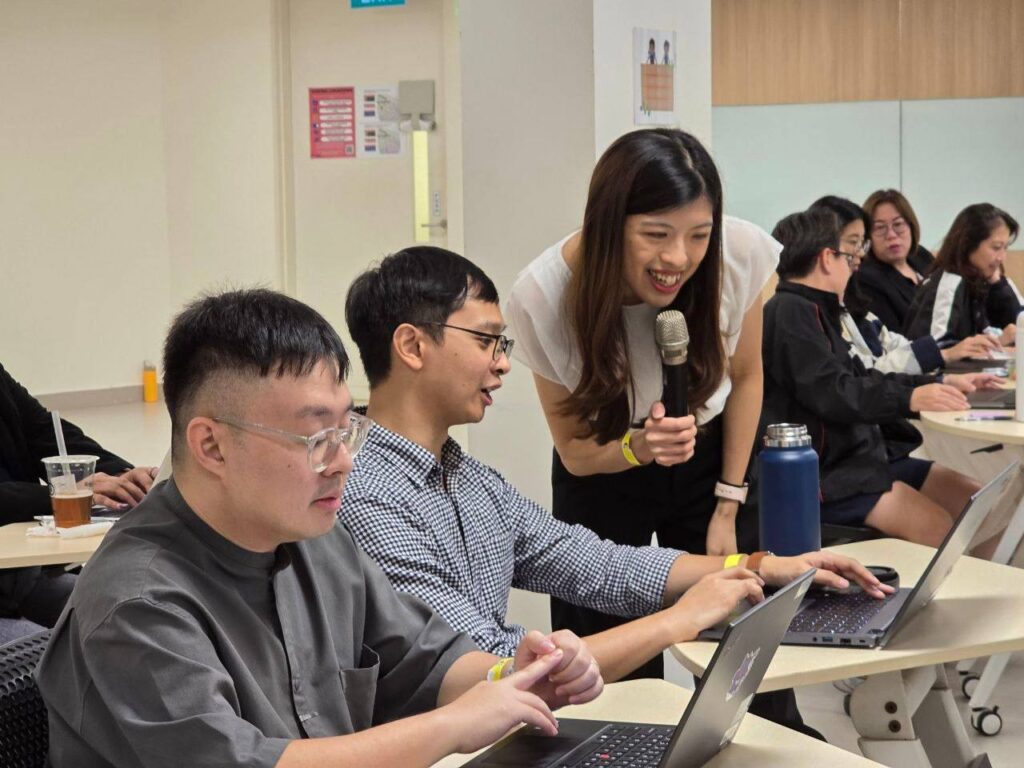
Moving beyond theory, the session transitioned into an intensive hands-on practice segment. Using the ScholAIstic platform, participants stepped into the role of AI designers, building and testing their own simulation chatbots. This practical application allowed educators to explore the nuances of prompt engineering and chatbot behavior across various classroom scenarios.
A key focus of the workshop was the integration of personalized feedback loops. Educators explored how AI can be programmed to recognize individual student needs, offering tailored guidance that mimics a 1-on-1 tutoring experience. This approach underscored a “Pedagogy First” philosophy, ensuring that technology serves to identify student gaps and provide real-time, constructive support.
Building a Future-Ready Educational Ecosystem
The workshop concluded with a robust exchange of ideas on maintaining ethical standards and student well-being within AI interactions. The deep engagement of the S7 Cluster participants highlighted a shared commitment to fostering “Future Capabilities” in their respective schools.
This collaboration marks a significant step forward in integrating AI into the Singapore curriculum, transforming simulation chatbots into meaningful partners that empower both teachers and students in a safe, digital-first environment.
Leave a Reply