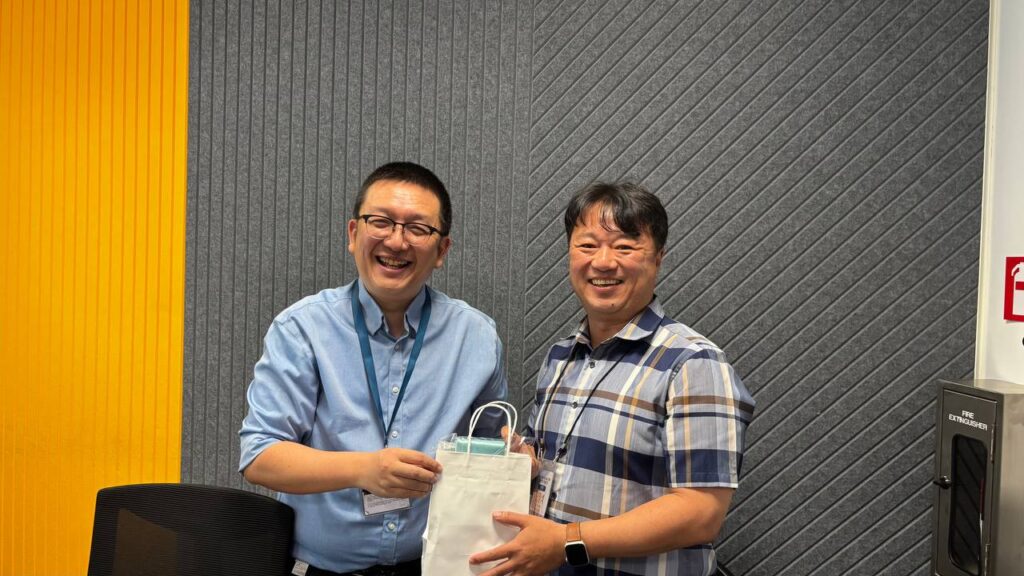
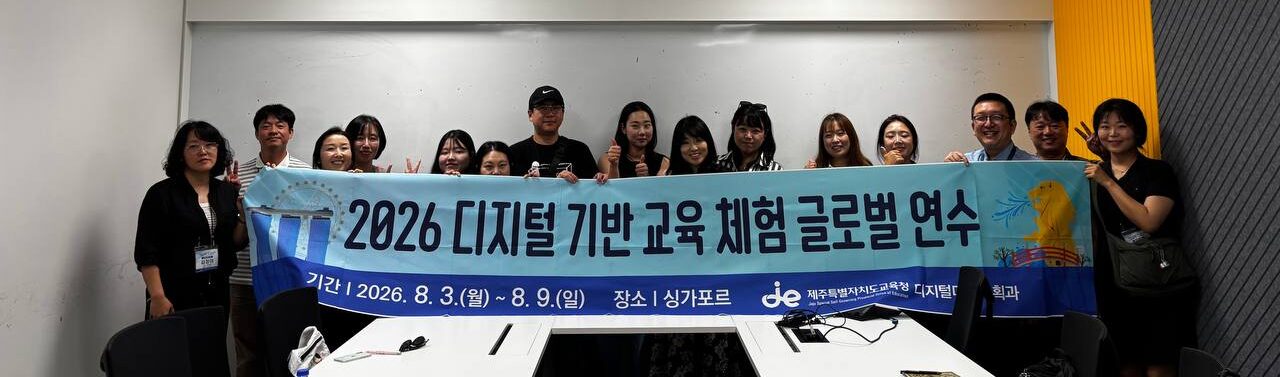
On 5 August 2026, AICET hosted a delegation of teachers representing elementary, middle, and high schools across the province and education officials from Jeju Special Self-Governing Provincial Office of Education, South Korea. The visit was hosted by Prof. Soo Yuen Jien, AICET’s Deputy Director (Pedagogy and Research).
Setting the Tone: NUS’s AI Policy
Prof. Soo opened by outlining NUS’s foundational stance towards AI in education: embrace it, rather than resist it, while paying close attention to considerations such as modality, keeping a human in the loop, and treating AI-detection tools as indicative rather than conclusive.
From Knowing to Creating: A Progression for Educators
Prof. Soo walked the delegation through a progression educators typically move through as they build AI fluency — starting with simply knowing what generative AI is and which tools are common, to applying it through effective prompting and assessment design, to customising prompts and workflows for their own courses, and eventually creating entirely new AI-enhanced tools where standard options fall short.
Common, off-the-shelf AI tools, he explained, are generally supported through NUS’s Centre for Teaching and Learning Technologies (CTLT) via workshops and consultations, while more novel or customised applications fall under AICET’s remit through consultation, project work, and formal proposals.
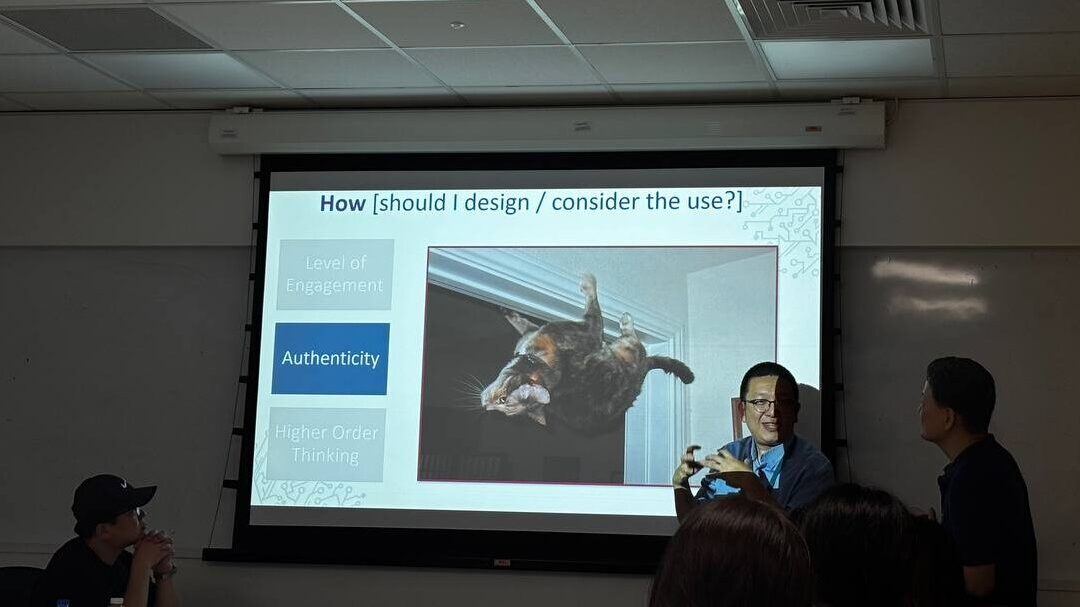
To help decide how much a given task should lean on AI versus human input, Prof. Soo shared a design framework built around the “delta” between AI and human contribution across three levels of engagement, authenticity, and higher-order thinking — whether a use case should merely make an existing process better, actively co-create it alongside a human, or hand it over to AI almost entirely.
Use AI: Examples from NUS Classrooms
He grounded this framework with live examples from NUS classrooms. In a Law module, students practise trial advocacy skills by engaging with an AI-simulated courtroom scenario. In the Faculty of Science, a Physics module has students learn scientific inquiry by trying to “convince” a chatbot of their reasoning. In an Engineering module, students have explored scientific concepts through an AI art hackathon, using generative tools to visualise abstract ideas. Across these examples, Prof. Soo emphasised that GenAI tools are being used in varied ways — as idea generators, role-play personas, personal writing or coding assistants, teaching assistants for guided practice, and analysts that help identify at-risk students or patterns in assessment data.
Tools Built Around Real Pedagogical Problems
Prof. Soo also touched briefly on how AICET’s engineering team supports this pedagogical vision in practice — starting from a genuine teaching pain point, building software to address it, and validating and iterating with real users. He pointed to SoftMark, a plagiarism detection tool for software assignments that helps instructors uphold academic integrity as more coding work is completed with AI assistance, and ScholAIstic, AICET’s newer agentic-AI learning platform. He was careful to frame these as pedagogy-led rather than technology-led: anyone can build a chatbot, he noted, but the harder and more valuable work lies in the teaching design behind it.
Looking Ahead
Prof. Soo closed by sharing a simple framework for how educators might respond to an AI-driven future: learn how to learn, do the right things, ask the right questions, and place renewed emphasis on human skills.
The visit gave the Jeju delegation a close look at how AICET combines pedagogical research with engineering practice to build AI tools for real classroom needs, and offered an opportunity for exchange between Singapore and Korean educators on shared challenges in bringing AI meaningfully into teaching and learning.