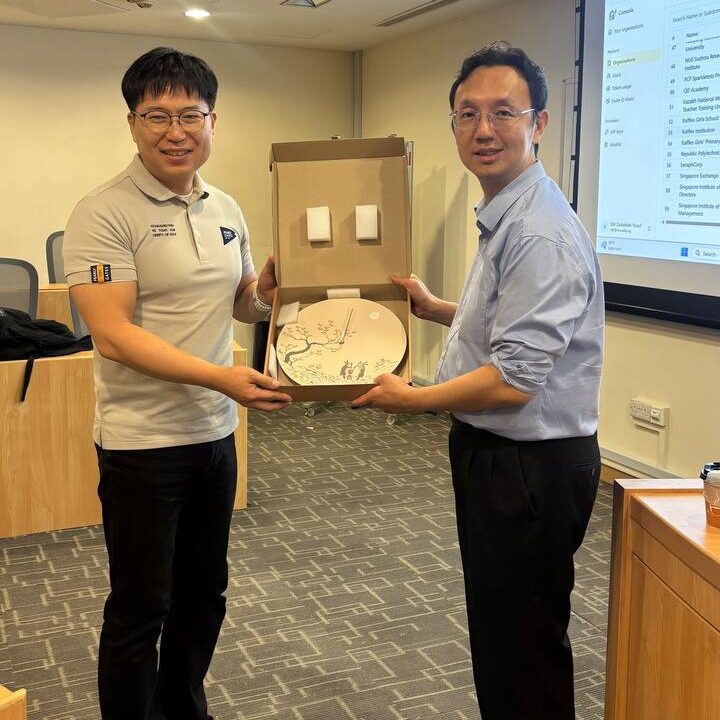
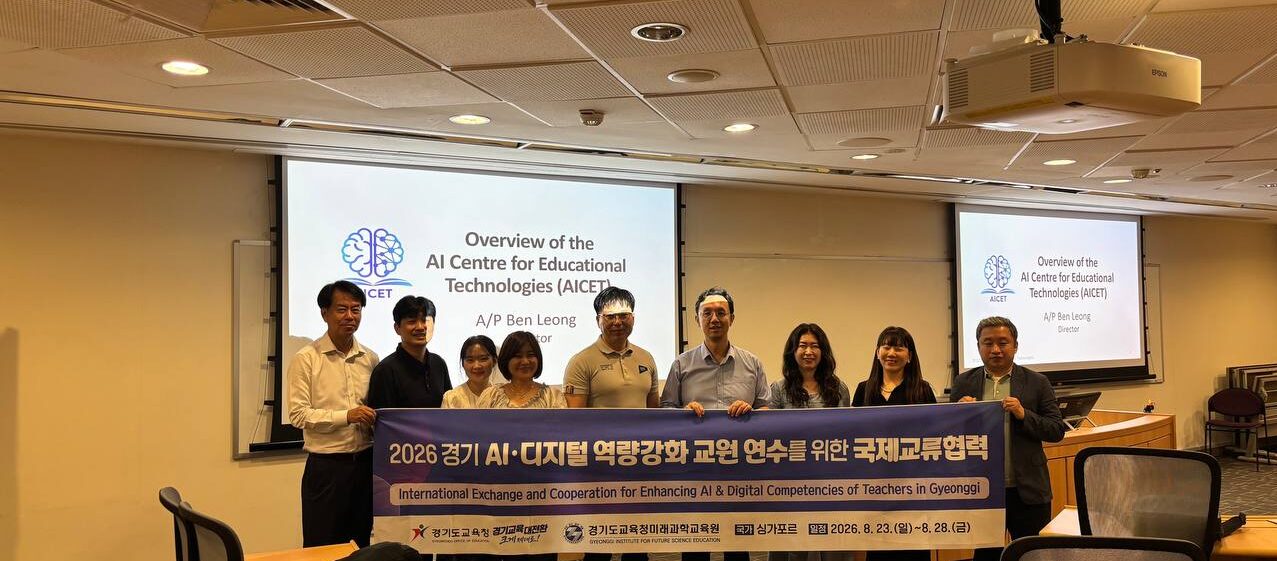
On 26 August 2026, AICET hosted a delegation from the Gyeonggi Provincial Office of Education, Korea’s largest provincial office of education. The visit was hosted by Prof. Ben Leong, Director of AICET. The delegation comprised senior officials and researchers from the Gyeonggi Provincial Office of Education, including the Head of its Future Education and Training Department, educational researchers, scholars, an officer, and a representative from the Gyeonggi Institute for Future Science Education.
The Gyeonggi Provincial Office of Education plays a leading role in advancing AI and digital education programs for elementary, middle, and high school teachers across the province. As part of its efforts to foster future-oriented education, the office has been driving initiatives in digital learning, AI-based education, teacher professional development, and personalised learning. Among its recent efforts is ‘Hi-Learning’, an AI-based teaching-learning platform designed to support individualised student learning and enable teachers to design and manage their classes more effectively.
AICET’s Training Initiatives and AI Platforms
Prof. Ben gave an overview of AICET’s training initiatives and AI-related platforms, including ScholAIstic, Cikgo, and SoftMark, and how each supports different aspects of teaching and assessment at NUS.
He also spoke about how role-play simulations can be used for competency-based learning, drawing on four use cases across different disciplines. In Social Work, two instructors and 18 students have used seven chatbots roughly twice a year. In Nursing, three instructors and 200 students have engaged three chatbots at a similar frequency. At the Centre for Teaching and Learning Technologies (CTLT), two instructors and 160 students have used a single chatbot approximately six times a year, while in Law, two instructors and 130 students have used two chatbots once a year. Together, these examples illustrated how role-play-based tools have been adapted to fit the needs of different fields, from clinical communication to courtroom advocacy.
Innovation Strategy and Digital Ecosystem Insights
The conversation extended to AICET’s broader innovation strategy and its approach to building a digital ecosystem for education, giving the delegation insight into how institutional strategy and technology adoption work together to support teaching and learning at scale.
Building on delegation visits in September and December 2025—including members of the Gyeonggi Provincial Council’s Education Administration Committee—this visit reinforces the growing partnership between AICET and the Gyeonggi Provincial Office of Education.