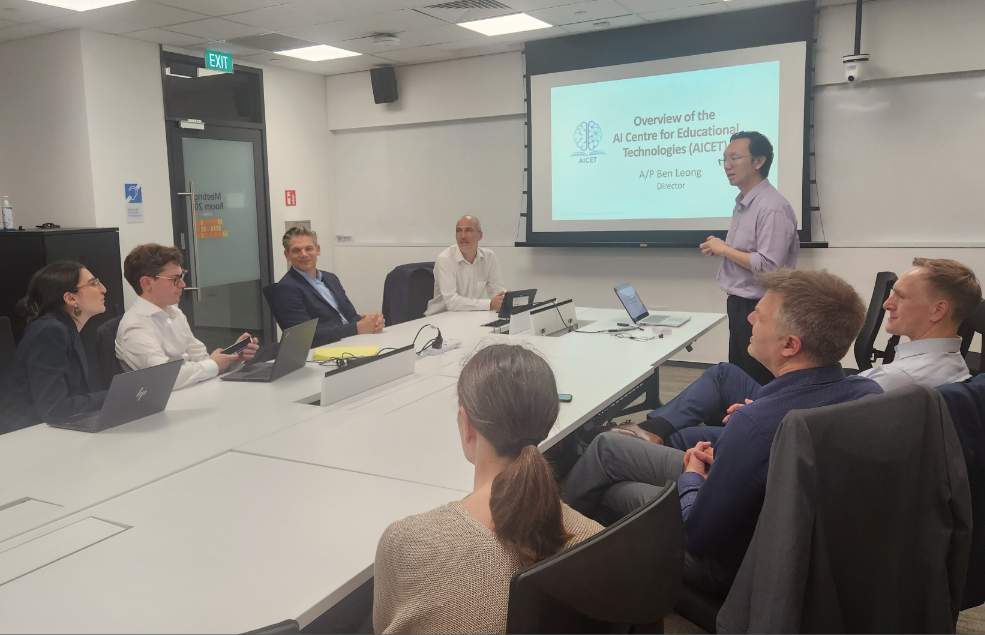
On 8 June 2026, AICET was delighted to host a distinguished delegation of eight participants from the Hasso Plattner Institute (HPI), led by Prof. Dr. Tobias Friedrich (Dean and Managing Director) and Dr. Henrik Haenecke (Chief Financial Officer).
HPI, Germany’s leading technology university for computer science and digital engineering, is currently benchmarking world-class institutions across Asia to inform the vision of their upcoming “Campus of the Future”. The delegation — which included academic leaders, strategic advisors, the project’s lead architect, and consultants from McKinsey & Company — visited AICET to explore next-generation learning models, the evolution of physical teaching spaces, and the shifting value proposition of universities in the age of AI.
The session opened with a presentation by Prof. Ben Leong, who reflected on the global educational shifts following the COVID-19 pandemic and provided an overview of AICET’s journey to the present. Drawing on Singapore’s experience as a pioneer in integrating AI into education, he highlighted key insights into the efficiency and effectiveness of AI adoption in schools.

Addressing common concerns surrounding digital tools, he emphasized a crucial perspective:
“Tech problems are easy. The hard problems are the people problems.”
Rather than chasing technological novelty, Prof. Ben Leong reaffirmed that teachers must remain at the heart of educational transformation. He emphasized that true innovation must be driven by actual instructional needs and student learning behaviors, noting that technology alone does not improve education; it is human judgment and a sound pedagogical framework that unlock its true value.
The presentation sparked a highly engaging and vibrant Q&A session focused heavily on the future of Computer Science education and campus design.
To deepen the delegation’s understanding, Prof. Ben Leong led an interactive session where the participants directly simulated and experienced AICET’s educational chatbots together. This hands-on simulation vividly demonstrated how AI can be leveraged effectively.
The exchange of ideas provided invaluable insights for both organizations. As HPI continues to sketch out the physical and digital architecture of its “Campus of the Future”, AICET remains committed to pioneering pedagogical models that demonstrate how technology can elevate — rather than sideline — the critical role of educators.