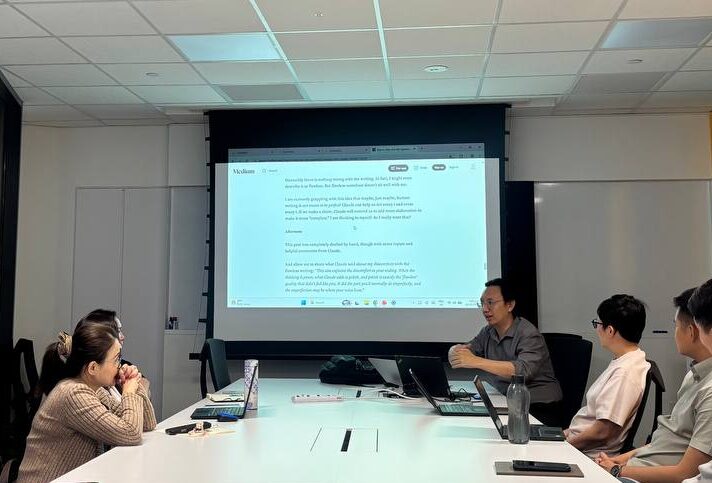
On 12 October 2026, Prof. Ben Leong, Director of AICET welcomed a delegation from Singapore’s Ministry of Manpower Academy (MOMA). The session gave the delegation an overview of AICET’s approach to using AI in education, a look at the Centre’s platforms in use today, and an opportunity to discuss how these tools might support learning beyond the classroom. Prof. Ben covered AICET’s pedagogy-first approach, the risks and opportunities AI presents for learning, and how the Centre’s platforms are being used to train and assess human skills.
A Pedagogy-First Approach
Prof. Ben opened by noting that innovation in education is fundamentally a pedagogy problem, not a technology one. AICET’s aim is not to replace teachers, but to build tools that help them teach better: improving efficiency and monitoring, and making room for new approaches and experimentation.
Using AI Well
Prof. Ben then addressed growing evidence that AI can hinder learning when used without care. He cited a June 2026 study of more than 26,000 secondary school students in China, which found that generative AI adoption raised homework scores but lowered performance in closed-book examinations. Rather than asking whether learners should or should not use AI, he argued that the focus should be on judgment and domain mastery.
AI acts as a force multiplier: it amplifies the abilities of those with sound judgment, but cannot substitute for them. Learners should use AI for tasks they do not want to do, not for tasks they cannot yet do.
He added that effective AI adoption is ultimately a people problem, with time and expertise being the main barriers. To address this, AICET has offered consulting support to NUS educators since July 2024, helping them apply AI to enhance their teaching.
Training Human Skills with AI
A key focus of the session was the use of AI to train and assess human skills such as leadership, communication and social skills, which have traditionally been difficult to teach and assess at scale.
Prof. Ben introduced ScholAIstic, AICET’s agentic-AI learning platform, which gives learners access to 57 large language models while allowing instructors to see how students interact with AI. Since its official launch in 2025, the platform has recorded more than 6,000 unique users and 32,000 conversations. Its role-play chatbots are used in courses spanning social work, nursing and law, guiding learners through realistic scenarios followed by reflection and AI-generated feedback. He also previewed upcoming features, including multi-user chatrooms in which several learners and AI agents interact, with instructors able to join at any time.
Prof. Ben also introduced KouShi, which aims to give every student an AI teacher for speaking practice. While students preparing for the PSLE practise written papers repeatedly, many have only a handful of chances to speak before their oral examinations. KouShi addresses this gap through LaoShi, a friendly AI teacher that holds live, two-way conversations with students in a format similar to the actual exam. Teachers assign the practice, while LaoShi provides the one-to-one speaking time that is difficult to find in a busy classroom. After each session, students receive a clear report with actionable feedback.
Prof. Ben concluded by reminding the delegation that technology is no silver bullet. The technical problems are often the easier ones; the harder problems lie in how people adopt and use these tools. AICET thanks the Ministry of Manpower delegation for their visit and the engaging exchange.