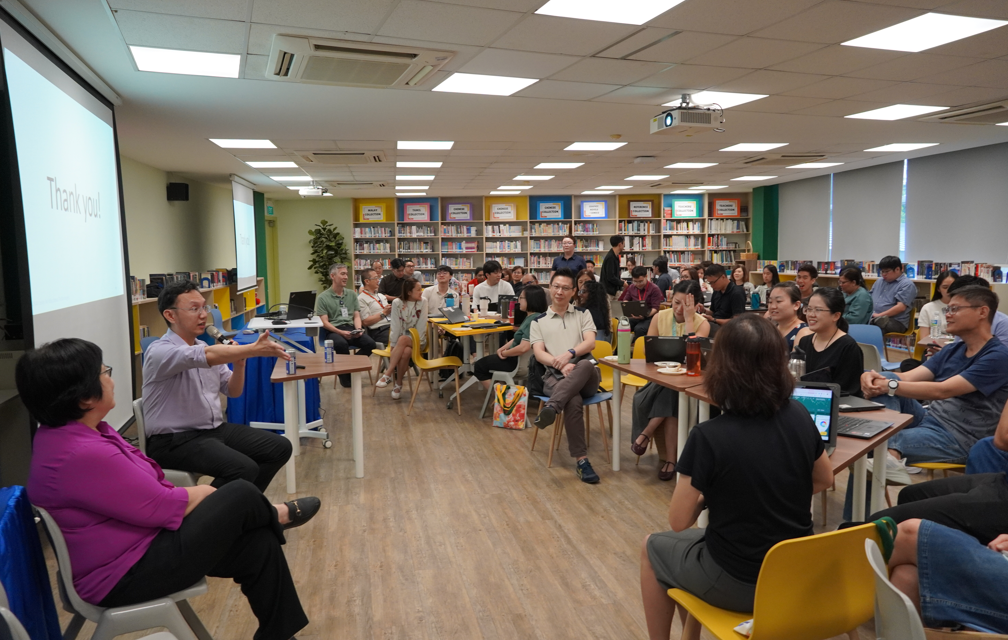
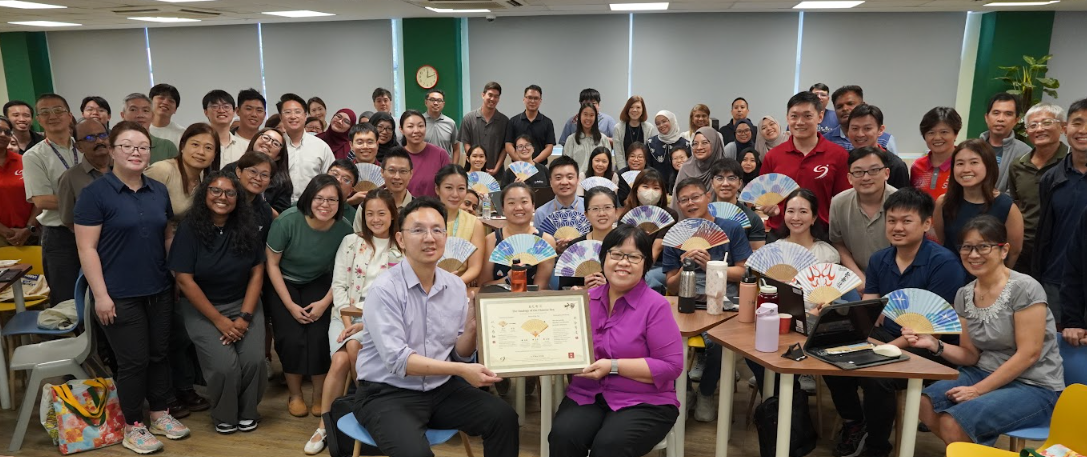
On 16 November 2026, Prof. Ben Leong, Director of AICET, spoke to educators at Riverside Secondary School on how schools can prepare students for an AI-driven future.
The talk, titled The AI-Ready Educator, centred on one argument: AI expands what is possible in the classroom, but pedagogy decides what changes for the better. Drawing on his experience at NUS, with the Ministry of Education from 2014 to 2019, and at AICET since 2021, Prof. Ben framed the session around four questions: how AI affects learning, whether students will still have jobs, what schools should teach, and how AI should be used.
AI and Learning
Prof. Ben opened by making clear that he was not there to persuade teachers to use AI in their teaching. Instead, he asked the audience to consider how AI is already reshaping what happens in and out of the classroom, with teachers using it to prepare lessons and students using it to complete homework.
He pointed to growing evidence that unguided use of technology can hurt learning. Among the research he cited was a June 2026 study, The Generative AI Learning Penalty, which followed 26,811 secondary students across nine schools in China over 30 months. He also noted that several countries have moved to restrict AI use among children.
The underlying issue, he argued, is cognitive offloading: students handing over the thinking that learning requires. In his view, this is less a cognitive problem than one of discipline and self-regulation, which places it squarely within the work of schools.
Will Students Still Have Jobs?
On employment, Prof. Ben suggested that AI itself is not the main concern for students. The larger challenge is a tightening global job market, where the number of young people entering the workforce is expected to outpace the jobs available.
He observed that Singapore's students will increasingly compete not with average workers elsewhere, but with the most capable people in lower-cost countries who are also using AI. Workers who can use AI well are likely to pull further ahead, while those who cannot may fall behind. Against this backdrop, he encouraged educators to help students stay open to career paths beyond traditional white-collar work.
What Should We Teach?
Prof. Ben reminded the audience that in education, few ideas are truly new. The emphasis on preparing students for uncertainty and on 21st-century competencies remains relevant, and AI makes it more urgent.
He highlighted several priorities: teaching students how to learn, asking the right questions, becoming comfortable with ambiguity, and taking the perspectives of others. These human skills, such as creativity, judgement, leadership and social awareness, are areas where AI remains weaker, yet they are also the hardest to teach and assess.
He noted that AI may itself help schools teach and assess these skills. At the same time, he acknowledged that national examinations strongly shape what happens in schools, leaving an open question for educators: how to balance academic results with life skills.
Using AI Well
For students, Prof. Ben offered a simple principle: use AI for tasks you do not want to do, not for tasks you cannot yet do. He summarised good practice in three steps:
Think first. Attempt the task independently by forming an idea or drafting an answer.
Use AI second. Ask for hints, explanations or feedback, and compare the response with your own work.
Reflect afterwards. Revise in your own words and explain what you learned and why you made changes.
For teachers, he argued that real gains will not come from adding AI to existing workflows, but from rethinking how lessons are delivered and how learning experiences are designed. He illustrated this with a leadership course he is teaching this semester, in which students practise coaching conversations with an AI role-play partner. The activity is structured around a coaching model, with reflection built in between meetings and AI-generated feedback at the end.
His point was that anyone can build a chatbot, but making it effective for learning requires sound pedagogy.
Teaching as a Craft
Prof. Ben cautioned that AI does not make anyone a good teacher. As a force multiplier, it amplifies the judgement of the person using it, and can make poor practice worse. Without care, widespread use of AI also risks pulling work towards mediocrity.
His response was a call to focus on craftsmanship. Teaching, he said, is a craft that rewards sustained effort, and domain mastery and judgement will matter more as AI widens gaps between people. Teachers and students alike need to know what good work looks like.
Education and Values
Prof. Ben closed by returning to the purpose of education: guiding students to lead good lives. He ended with a reminder that, whatever the technology, teaching is ultimately about heart. The session concluded with a question-and-answer segment with the audience.