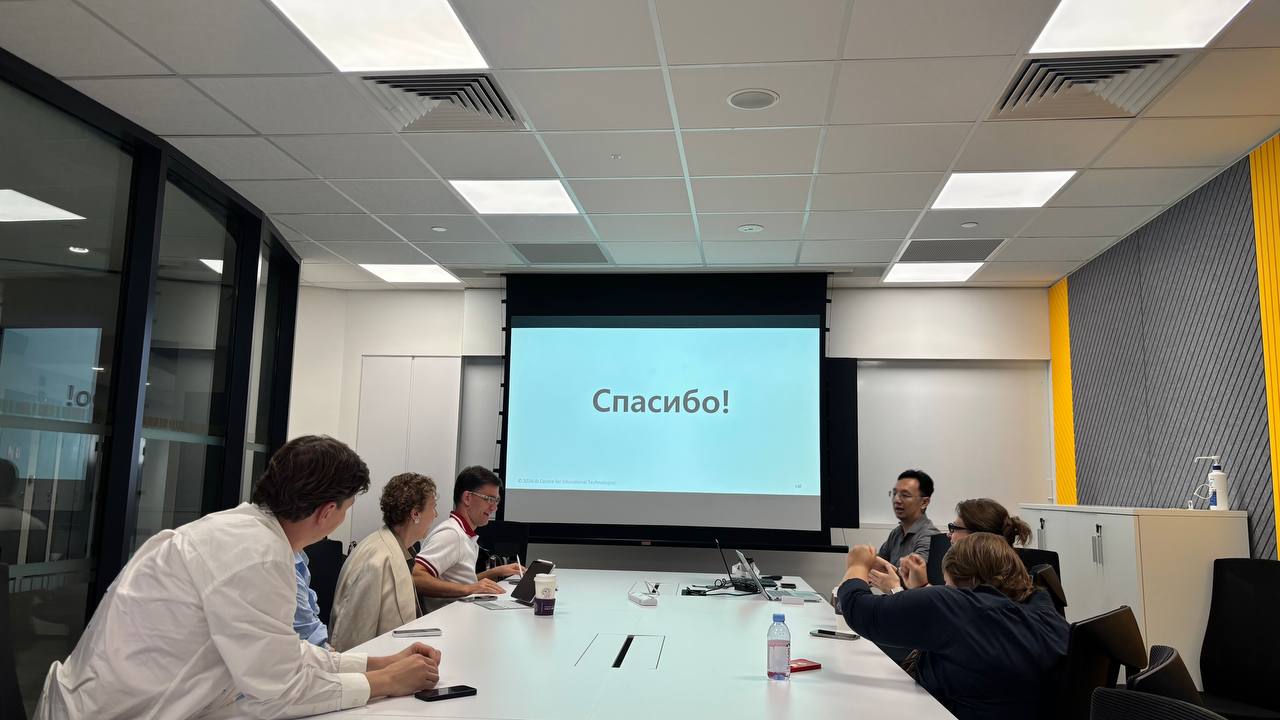
On 30 October 2026, AICET hosted a delegation of educators from Primakov School in the Moscow Region. The delegation was led by Ms Maiia Maisuradze, Principal, and included Ms Anna Mara, Head of Leadership Department; Ms Irina Kurlykova, Head of Professional Development Department; Ms Viktoria Petrova, Head of Boarding; Mr Artemii Yeliseev, Vice-Principal for IT; Mr Ivan Savinykh, Producer and Teacher of Music; and Mr Daniel Pagnoccolo, Head of International Department. The session was led by Prof. Ben Leong, Director of AICET, who gave an overview of how the Centre develops its AI-based learning platforms, the platforms now in use across NUS and Singapore schools, and how AICET thinks about assessment and academic integrity in the age of generative AI.
A Pedagogy-First Approach
Prof. Ben opened with the principle that guides AICET’s work: the teacher is at the heart of improving education.
Innovation in education, he argued, is not a technology problem but a pedagogy problem. AICET therefore takes a pedagogy-first approach to developing and deploying technology, with the aim not of replacing teachers but of building tools that help them teach better. He outlined the Centre’s development cycle: identify real problems and opportunities, build AI-based software, iterate with real users, and make the solution sustainable. Newer AI capabilities such as mimicking human interaction, approximate reasoning, multi-agent interaction and multilingual support open up teaching possibilities that were not practical before.
Prof. Ben also introduced AICET Consulting, which since July 2024 has worked with NUS faculty to discover new applications of AI in teaching. Through a Request for Proposals focused on self-directed learning, instructors propose projects that tackle in-class pedagogical challenges in areas such as students’ cognitive, affective and behavioural skills, and teaching efficiency.
AI Platforms in Practice
The delegation was introduced to ScholAIstic, AICET’s agentic-AI learning platform, which gives instructors access to 36 large language models and lets teachers see how students interact with AI. Since its official launch in 2025, the platform has recorded more than 6,000 unique users, 32,000 conversations and 313,000 user messages (as of July 2026).
Prof. Ben highlighted role-play as a key use case for competency-based learning, with chatbots deployed in Social Work, Nursing and Law, and a parent engagement role-play developed for the Ministry of Education. Drawing on a leadership course he is teaching this semester, he demonstrated a coaching role-play built on the GROW model (Goal, Reality, Options, Will). Trainees meet a simulated staff member, reflect on their approach, continue the conversation, self-evaluate, and receive AI-generated feedback. As he noted, anyone can build a chatbot; what makes it effective is the pedagogy behind it.
He also previewed ScholAIstic’s next steps: multi-agent and multi-user chatrooms where groups of students can interact with several AI agents and instructors can join at any time, and multimodal features that combine chat, voice, file uploads and document editing.
Assessment and Academic Integrity
In the final segment, Prof. Ben outlined Singapore’s position on AI in education: teach students how to use AI and learn with it, blend AI with other approaches that support learning, and put guardrails in place. Assessment should remain aligned with learning outcomes, assess for mastery, keep students responsible for their own learning, and encourage academic integrity. AI use should also be age-appropriate, moving from light and supervised use in primary school towards ethical, independent use at tertiary level.
He argued that policing plagiarism alone is a losing battle, because misuse of AI is less a cognitive problem than one of discipline and self-regulation. His advice to students is to use AI for tasks they do not want to do, not for tasks they cannot yet do. Used with good judgment, AI is a force multiplier; more AI does not automatically mean better learning. As AI handles more routine work, he suggested, education should place greater weight on human skills such as creativity, leadership and communication, and AI itself can help assess and train these skills.
Closing
Prof. Ben concluded that while technology problems are comparatively easy, the hard problems in education are people problems, and that teaching is ultimately about heart. AICET thanks the educators from Primakov School for their visit and looks forward to continued exchange.