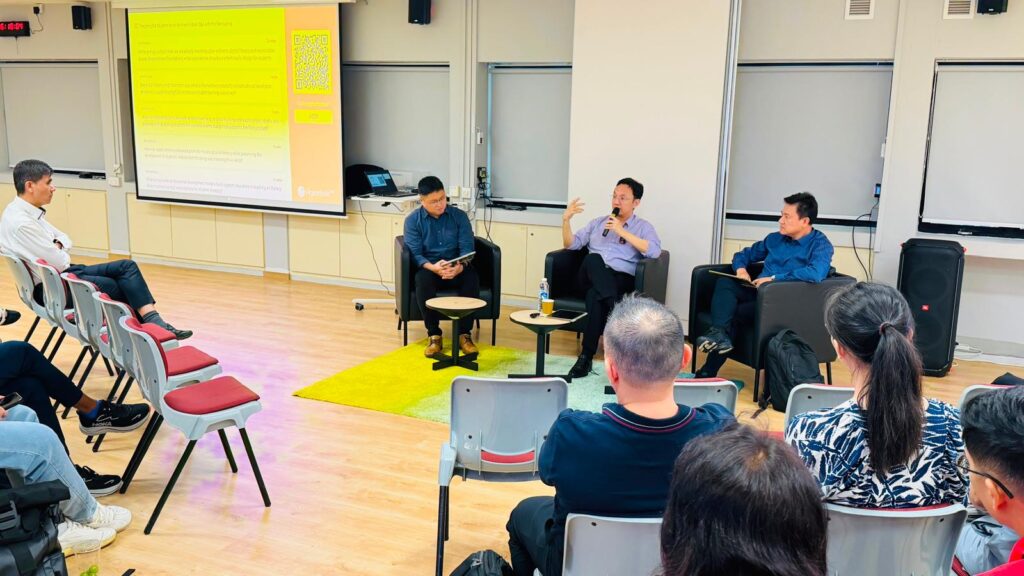

On 28 July 2026, AICET Director Prof. Ben Leong delivered a talk to educators at the E3 Cluster EdTech Network Learning Community (NLC) event, held at Dunman Secondary School. Prof. Ben shared a wide-ranging, personally-crafted take on how schools should think about AI’s impact on learning, the future of work, and what should be taught differently as a result.
Cognitive Offloading and the “Copilot vs Autopilot” Problem
Prof. Ben opened by posing a set of questions educators are grappling with today:
- How to prevent cognitive offloading
- What separates good AI use from over-reliance
- How assessments should adapt against the backdrop of national exams
- What AI skills students actually need
- What this means for professional development
To distinguish productive from harmful AI use, he offered a “Copilot vs Autopilot” framing: used well, AI plus a human produces something better than AI alone; used as an autopilot, the human’s judgment disappears entirely and the output degrades to whatever the AI alone would produce — or worse, if the human contributes poor judgment rather than none at all.
He was careful to frame this as fundamentally a problem of discipline and self-regulation, rather than a cognitive one.
Will There Still Be Jobs?
Turning to the future of work, Prof. Ben argued that the more pressing competitive threat facing students is not AI itself, but AI-augmented talent in lower-cost countries — students are not competing against an average worker elsewhere, but against that country’s most capable people, enhanced by AI.
He referenced concerns raised globally about a widening gap between the number of young people entering the workforce over the next 15 years and the number of jobs likely to be available to them, describing this as a structural problem beyond any single country’s control.

So, What Should We Teach?
On what should change in classrooms, Prof. Ben’s central message was that AI has not created new skills so much as made long-neglected ones newly urgent: metacognition and learning how to learn, comfort with ambiguity, perspective-taking, and character. He referenced the idea of “never-skilling” — a risk, distinct from de-skilling, in which learners who rely on AI too early in their development never form the foundational reasoning skills they will later need. He also cautioned against mistaking AI-assisted output for genuine learning, noting that visible productivity does not necessarily reflect understanding.
He illustrated the point with a simple matrix of skills by how easy they are to teach or assess versus how well AI already performs them — noting that skills AI handles well (such as computation or basic writing) sit in contrast to skills AI still struggles with, like leadership, empathy, and creativity, which he argued deserve renewed attention in schools.
Quoting Lee Kuan Yew’s 1967 remarks on the importance of character education alongside literacy, he reiterated the need for schools to focus on values as much as skills as AI reshapes what students need to learn. Prof. Ben closed by returning to a theme that runs through much of AICET’s work: that teachers, and the values they impart, remain at the heart of improving education.