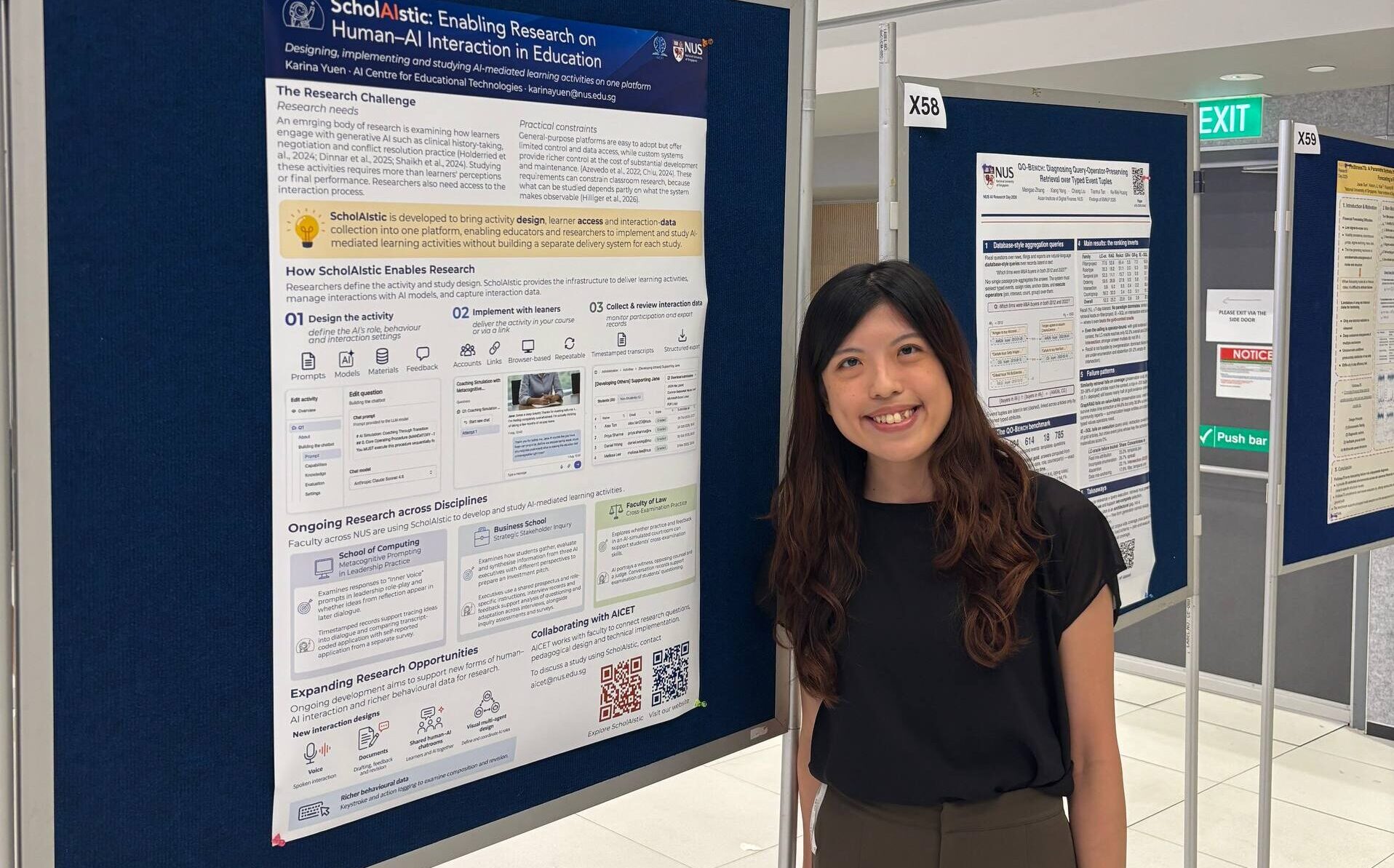
On 22 September 2026, AICET presented ScholAIstic at NUS AI Research Day, a university-wide event organised by the NUS Artificial Intelligence Institute (NAII) that brings together AI researchers, students, and industry and government partners. Held at NUS School of Computing, the event featured faculty spotlight talks and a poster and demonstration session showcasing AI research from across the university.
Karina Yuen, EdTech Development Specialist at AICET, recently demonstrated to an audience of researchers how ScholAIstic streamlines educational Human-Computer Interaction (HCI) research. The platform integrates activity design, student access, and interaction-data collection into a single, cohesive workflow.
The Research Challenge
A growing body of work is examining how learners engage with generative AI in activities such as clinical history-taking, negotiation and conflict resolution practice. Studying these activities requires more than learners’ perceptions or final performance: researchers also need access to the interaction process itself.
This is often constrained by the tools available. General-purpose platforms are easy to adopt but offer limited control and data access, while custom-built systems offer more control but require substantial development and maintenance. In practice, what can be studied depends partly on what a system makes observable.
How ScholAIstic Supports Research
ScholAIstic is designed so that researchers can focus on the activity and study design, while the platform handles delivery, AI model interactions and data capture. The workflow follows three stages:
- Design the activity: Researchers define the AI’s role, behaviour and interaction settings, including prompts, model selection, reference materials and feedback.
- Implement with learners: Activities are delivered in a course or via a link, run in the browser, and can be attempted repeatedly.
- Collect and review interaction data: Researchers can monitor participation and export timestamped transcripts in structured formats for analysis.
Ongoing Research across Disciplines
Karina also highlighted studies currently using ScholAIstic across NUS. At the School of Computing, researchers are examining “Inner Voice” metacognitive prompts in leadership role-play, tracing whether ideas from reflection appear in later dialogue. At NUS Business School, a study looks at how students gather and synthesise information from three AI executives with differing perspectives to prepare an investment pitch. At the Faculty of Law, students practise cross-examination in an AI-simulated courtroom, where the AI portrays a witness, opposing counsel and a judge.
In each case, the conversation records captured by the platform form part of the research data, supporting analysis of how students question, adapt and apply ideas over the course of an activity.
Looking Ahead
Ongoing development aims to support new forms of human–AI interaction, including voice-based interaction, document drafting and revision, shared chatrooms where learners and AI participate together, and visual design of multi-agent activities. Keystroke and action logging is also being developed to provide richer behavioural data on how learners compose and revise their work.