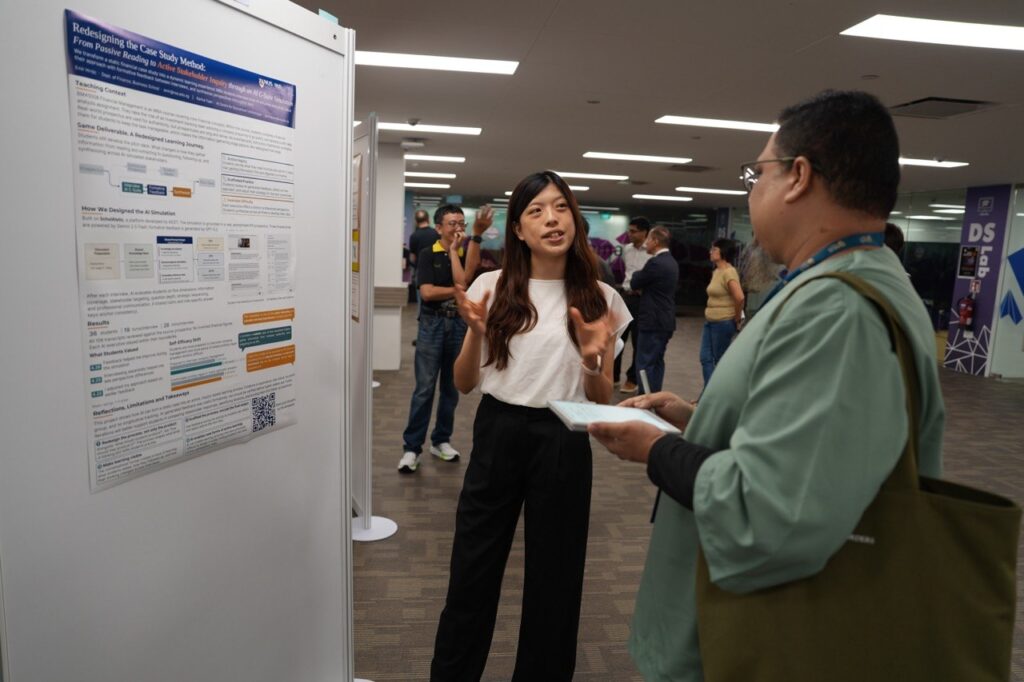
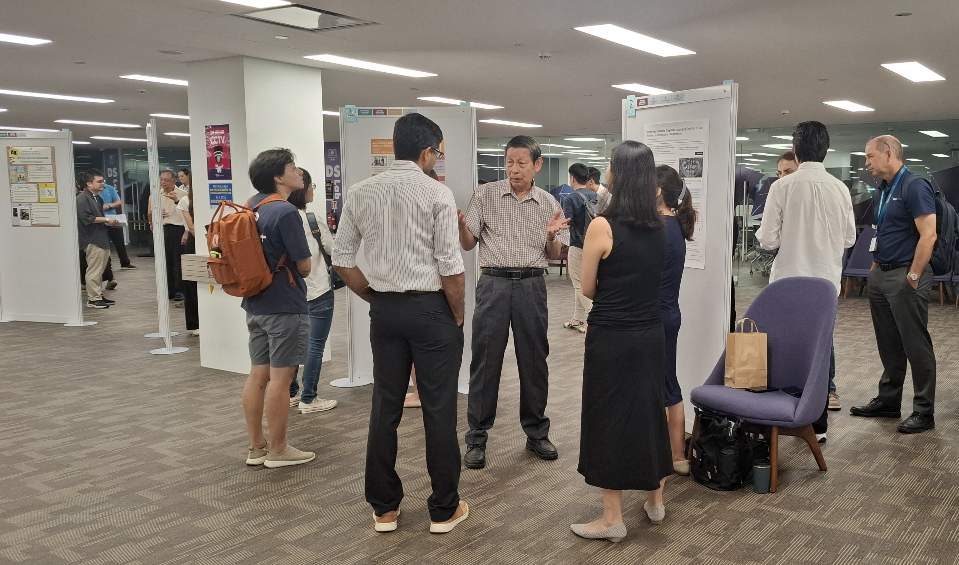
On 12 May 2026, AICET presented three projects at the ‘AI in Education: Poster Showcase of Teaching Breakthroughs‘ held at the NUS Central Library. Developed with faculty partners from Medicine, Business, and Dentistry, the posters highlighted how generative AI can be thoughtfully integrated into teaching when guided by clear learning needs, careful design, and educator oversight.
Rather than treating AI as a standalone tool, the showcased projects focused on how AI can support better learning processes: providing timely feedback, creating opportunities for professional practice, and helping students prepare more effectively for tutorials.
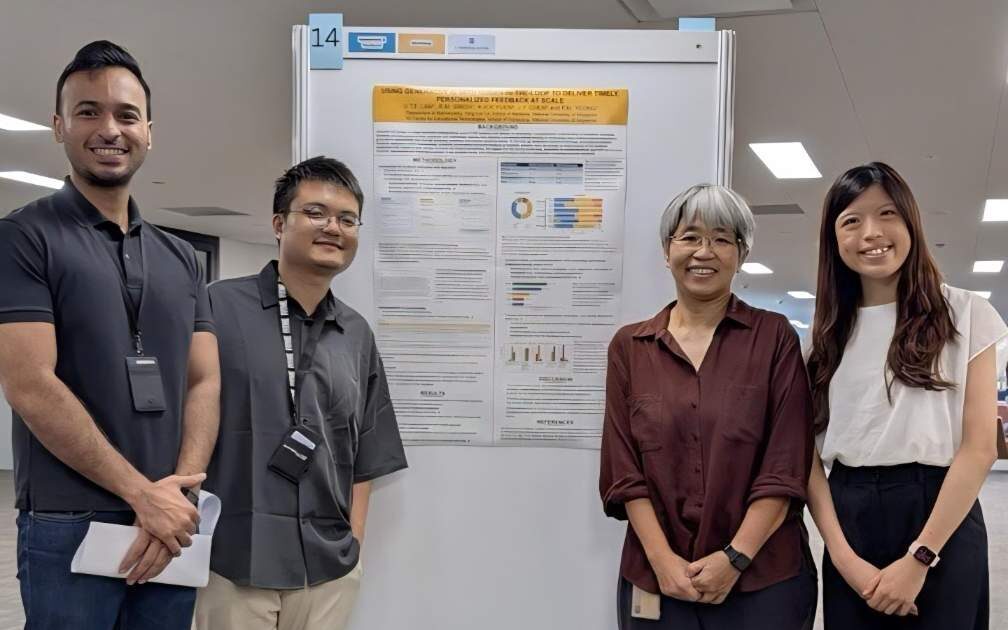
Scalable Personalised Feedback with Coursemology
In LSM2233 Cell Biology, AICET worked with Prof Foong May Yeong and her team from the Department of Biochemistry to support personalised feedback at scale through Coursemology. This project used a human-in-the-loop workflow in which generative AI produced draft feedback aligned with instructor-defined rubrics and model answers, while instructors reviewed and refined every response before release.
This approach helped reduce feedback time substantially while preserving instructor judgement and feedback quality. It also showed how AI-assisted evaluation can be designed to support, rather than replace, the pedagogical role of educators.
Redesigning the MBA Case Study with AI Stakeholder Interviews
For BMA5008 Financial Management, AICET collaborated with Dr Emir Hrnjic from Business School to redesign how MBA students gather information for a financial analysis assignment. Instead of relying mainly on a summarised IPO prospectus, students interviewed three AI-simulated C-suite executives: a CEO, CFO, and CPTO, each offering a distinct professional perspective.
Built on ScholAIstic, the simulation encouraged students to ask targeted questions, follow up on responses, and synthesise insights across stakeholders. Formative feedback between interviews helped students reflect on and improve their approach as the activity unfolded.
AI Tutoring for Dental Radiographic Interpretation
In OMS3100 Oral and Maxillofacial Medicine, Pathology and Radiology, AICET worked with Dr Lim Li Zhen from the Faculty of Dentistry to develop a Socratic AI tutor on ScholAIstic. The tutor gave students structured pre-class practice in dental radiographic interpretation, guiding them through description, categorisation, and differential diagnosis across five cases.
Before tutorials, instructors could review selected chat transcripts to identify common misconceptions and areas requiring further discussion. This allowed in-person class time to be used more purposefully for clarification, deeper reasoning, and targeted teaching.
Designing AI Around Learning
Together, the three projects reflect AICET’s approach to educational technology: start with a real teaching challenge, design around the learning process, and keep educators judgement central. Across disciplines, AI was used not to replace teaching, but to expand opportunities for practice, feedback, reflection, and active participation in learning.
The showcase also opened up conversations with the wider NUS community on how pedagogy-driven AI design can support meaningful, scalable, and responsible educational innovation.