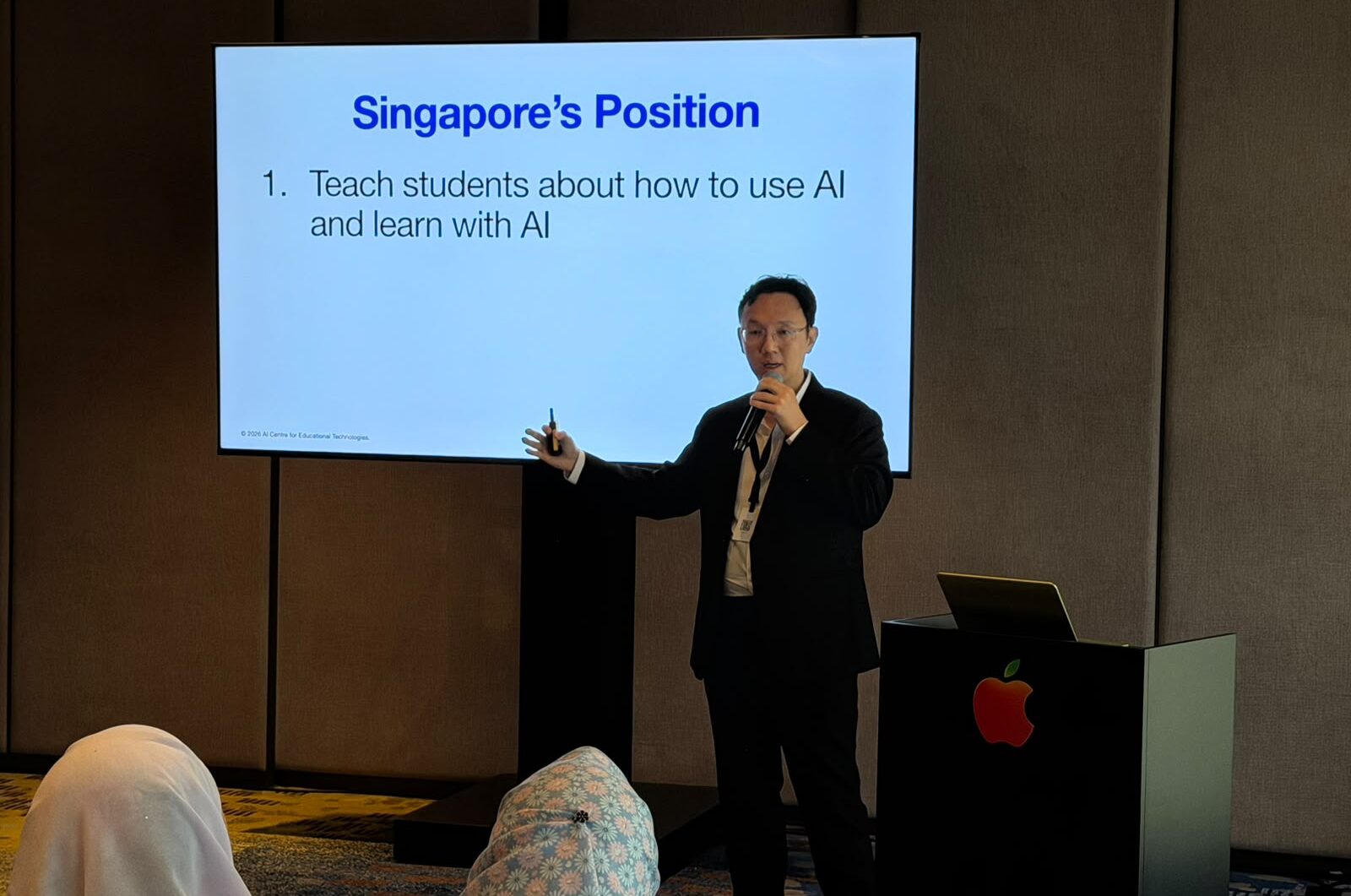
On 5 August 2026, Director of AICET Prof. Ben Leong was giving a talk at an Apple Education Leadership Forum held in Kuala Lumpur where he tackled one of the most pressing questions facing modern educators: how to navigate the role of Generative AI in education while ensuring students still engage in deep, meaningful learning. This event brought together regional education leaders, government officials, and innovators to shape the future of learning through technology, inclusive practices, and forward-thinking leadership.
The Dilemma of AI Adoption in the Classroom
Prof. Ben opened by challenging the audience to reflect on whether students should be encouraged or discouraged from using tools like ChatGPT. He pointed out that excessive time spent on technology can be counterproductive, citing research showing that more than one hour of digital leisure or more than three hours of digital learning both correlate with lower math scores. Warning of an “AI Chasm of Death”—where students rely on tools prematurely without transitioning from beginners to experts — he proposed a fundamental rule for AI adoption: students should use generative AI to do what they do not want to do, but never to do what they do not know how to do.
Singapore’s Strategic Approach and Assessment Reform
Addressing Singapore’s strategic position on educational technology, Prof. Ben emphasized a balanced approach. The goal is to teach students how to learn alongside AI, blend digital tools with traditional pedagogical methods, and set strong guardrails to protect the learning process. When it comes to assessment, educational practices must adapt by focusing on mastery and ensuring students remain accountable for their own learning and academic integrity. He stressed that AI integration should be age-appropriate, moving from light, highly supervised exposure at the primary level toward ethical usage in secondary schools, and ultimately full integration at the tertiary level.
Redefining Essential Skills for an AI-Driven World
Looking toward the future, Prof. Ben highlighted a major shift in the value of human skill sets. Technical tasks that are relatively easy to teach and assess, such as calculus, basic programming, and vocabulary — are precisely the areas where AI excels. Conversely, the skills that are notoriously difficult to teach and measure, such as leadership, emotional intelligence, creativity, and public speaking, are those where AI falls short. To demonstrate how educators can foster these human-centric abilities, he showcased AICET’s interactive coaching simulations, which guide learners through complex emotional scenarios and encourage metacognitive self-reflection.
Focus on the Human Element
Prof. Ben concluded his keynote with a striking reminder for the future of education: anything that AI can solve is ultimately an easy problem, whereas the real, enduring challenges will always be people problems.