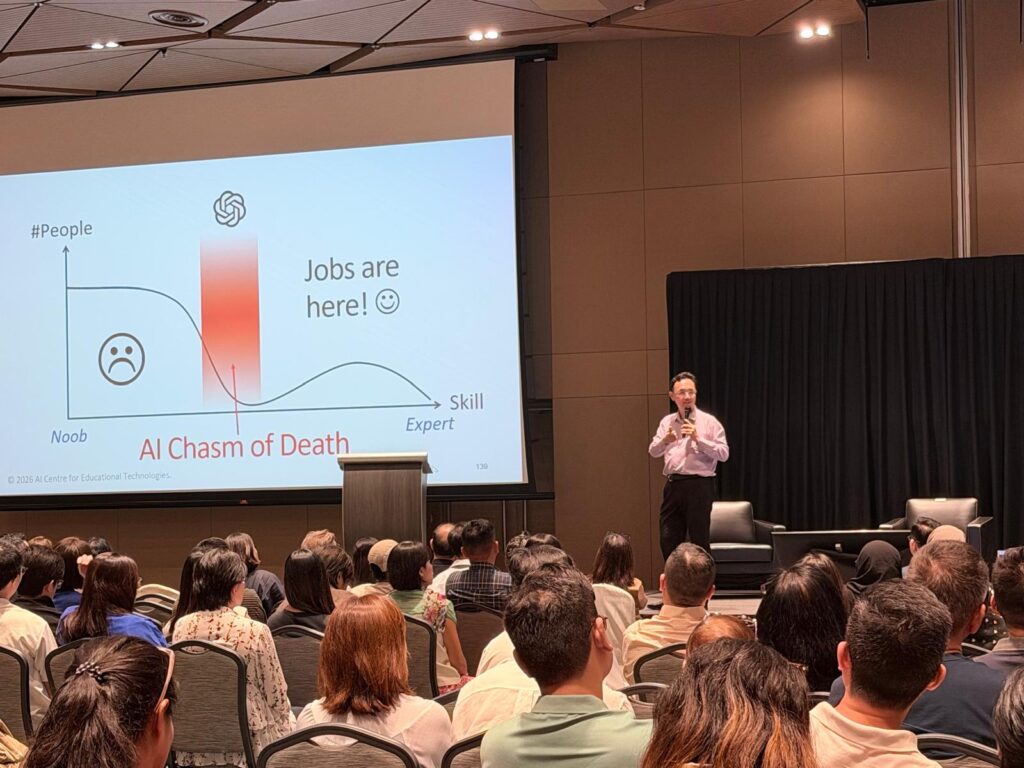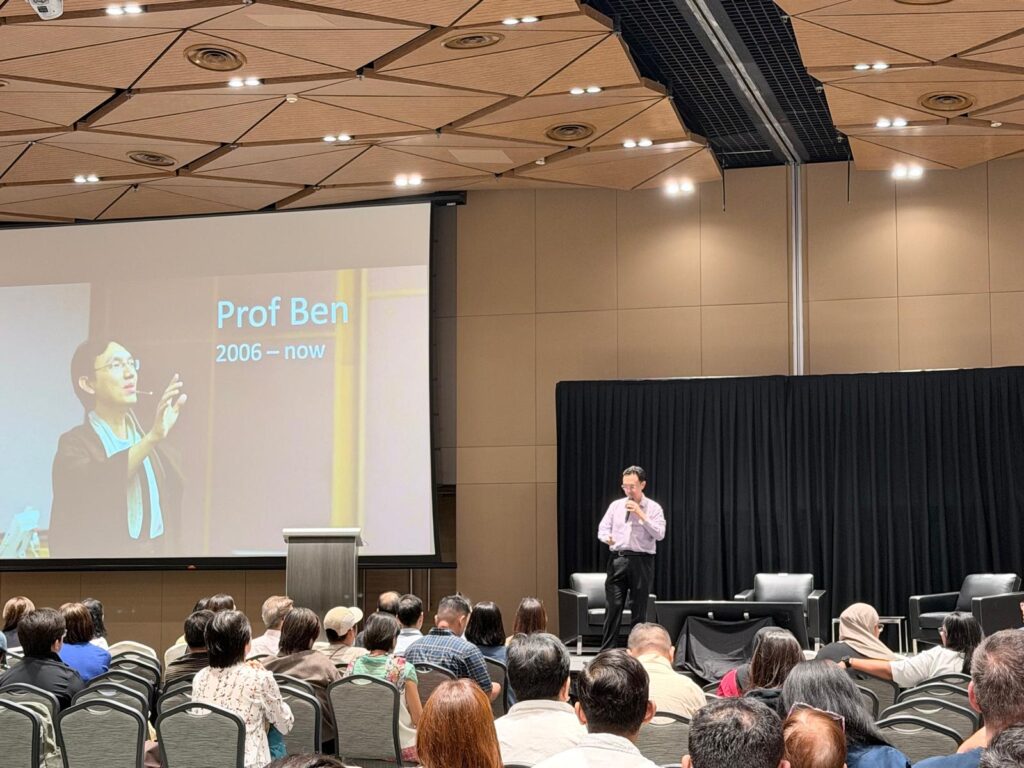
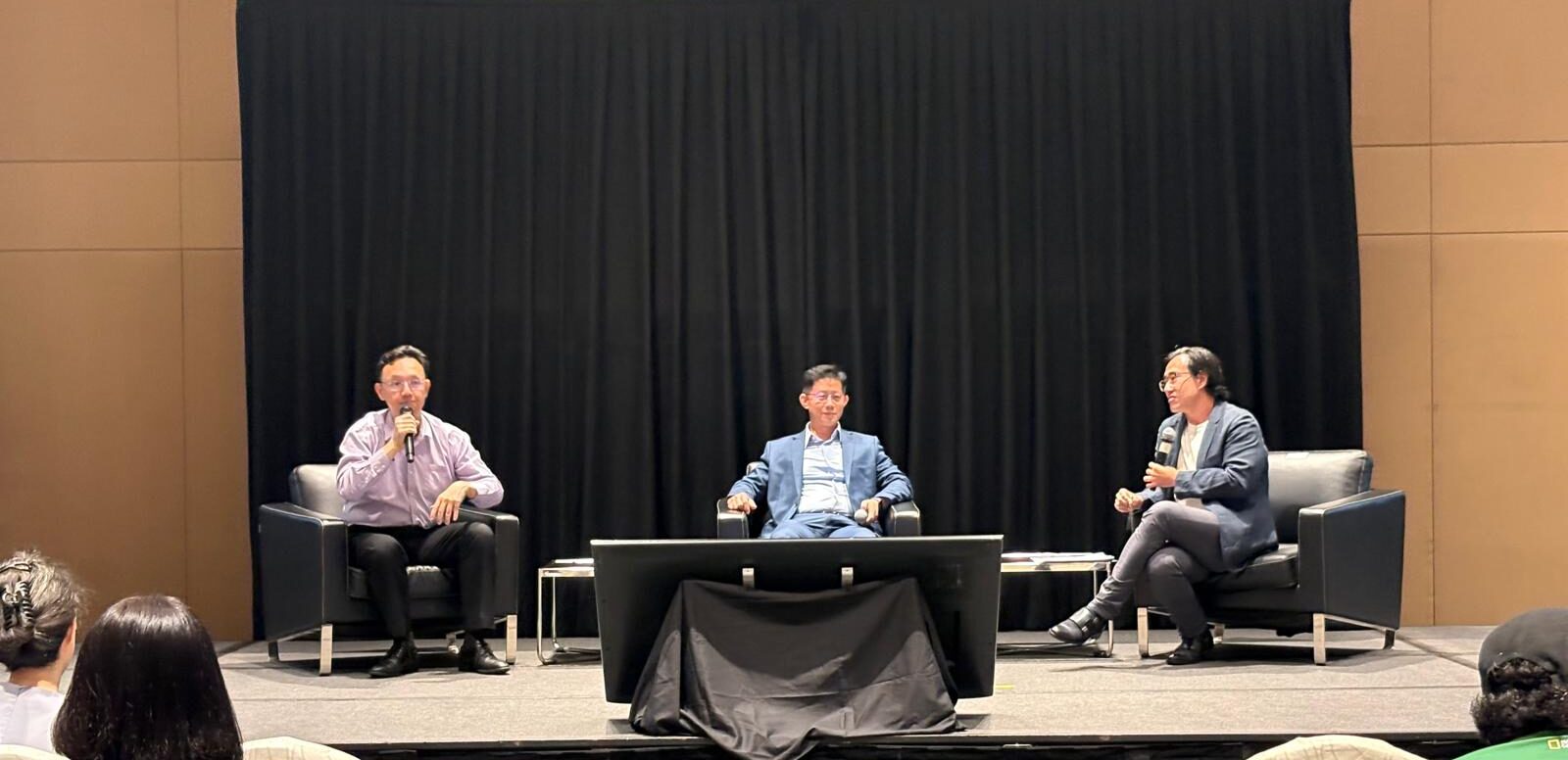
On 10 November 2026, Prof. Ben Leong, Director of AICET, delivered the keynote at MOE’s Student Development Curriculum Division (SDCD) Divisional Learning Day 2026. In his talk, “Preparing our students for an AI-driven future”, he made clear he was not there to convince teachers to use AI to teach. Instead, he addressed four questions: the risks of AI, how students should use it, what schools should teach, and how educators should use it.
Understanding the risks
Prof. Ben cited a June 2026 study, “The Generative AI Learning Penalty”, which followed 26,811 secondary students in China over 30 months, alongside recent news reports on AI’s effects on learning. The core risk is cognitive offloading: learners who hand their thinking to AI may never cross the “AI chasm” from novice to expert. This, he stressed, is not a cognitive problem but one of discipline and self-regulation.
How students should use AI
Students should use AI for what they do not want to do, not for what they cannot yet do. Prof. Ben summed up his advice in three steps: think first, use AI second, and reflect afterwards. That means attempting a task independently, using AI for hints and feedback, then revising in their own words.
What we should teach
Acknowledging that national examinations shape much of school practice, Prof. Ben argued that judgment and domain mastery matter more than ever: to use AI well, students must master their subject, not AI. He called for a focus on craftsmanship, noting that students need to know what “good” looks like to judge AI’s output — and that teaching, too, is a craft.
How educators should use AI
Layering AI onto existing workflows may yield gains of around 30 per cent, Prof. Ben observed; bigger leaps require redesigning the learning experience itself. Anyone can build a chatbot, he noted — what matters is the pedagogy.
He shared two examples. In his leadership course, students practise coaching with the GROW model and receive AI-generated feedback, with reflection built in throughout. In a Character and Citizenship Education scenario, students reason through a friendship dilemma while the AI probes their thinking without steering them to an answer. Both designs make students’ reasoning visible, not just their answers.
Prof. Ben urged schools to experiment only where they believe AI works, to be prepared to fail, and to guard against AI burnout. His recommendation: use AI to make teaching better, not faster.
Teaching is about heart
Prof. Ben closed by returning to first principles: education is about guiding students to lead good lives, which calls for a focus on character and values — 教书育人. In an age of AI, he reminded the audience, teaching remains about heart.