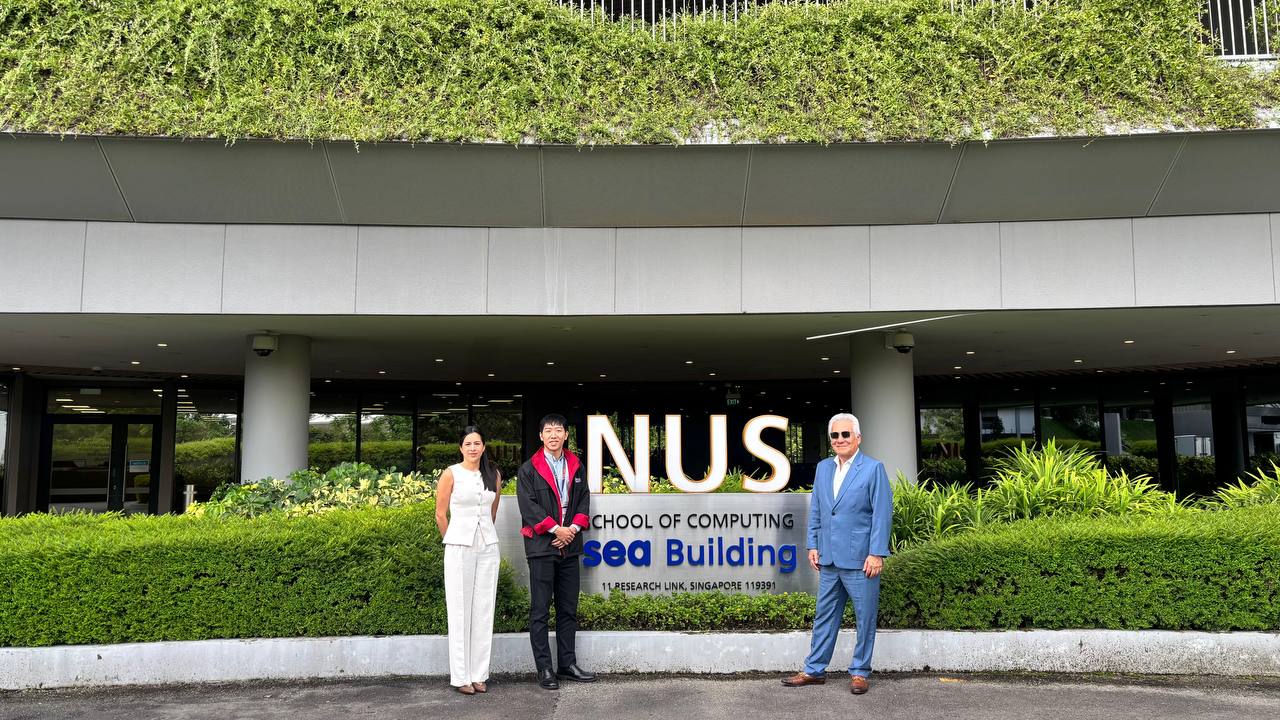
On 26 November 2026, AICET hosted a delegation of educators from Universidad de San Martín de Porres (USMP), one of the largest universities in Peru. Jonathan Chen, AICET's Deputy Director (Engineering), led the session, which combined a discussion of AI's place in education with an introduction to ScholAIstic, AICET's platform for AI-powered role-play learning.
The exchange focused on a question that educators everywhere are grappling with: as AI becomes part of everyday life, how should schools adapt, and where can AI genuinely improve learning?
A Shared Challenge
Jonathan set the context with a global picture. Around 1.2 billion young people in emerging markets are expected to reach working age over the next 15 years, according to the World Bank, and job creation is unlikely to keep pace. For students in Singapore and Peru alike, the competition they will face is international, and their competitors will be using AI.
At the same time, easy access to AI creates a temptation for students to skip the thinking that builds expertise. Jonathan argued that the answer is not to keep AI out of schools, but to teach students the discipline to use it deliberately: to think first, use AI second, and reflect afterwards.
Using AI to Teach Human Skills
Much of the debate about AI in schools focuses on what it can do for students. Jonathan turned the question around. The skills AI performs well, such as calculation or routine writing, are also the easiest for schools to teach and assess. The skills that will matter most, including leadership, communication, empathy and sound judgment, have traditionally been the hardest to teach at scale.
This, he suggested, is where AI can make its most valuable contribution: not by replacing these skills, but by giving learners safe and repeated opportunities to practise them.
ScholAIstic: Role-Play with a Purpose
Jonathan then introduced ScholAIstic, AICET's platform for AI role-play. On ScholAIstic, learners hold realistic conversations with AI characters in scenarios designed by educators, such as coaching a colleague through a difficult decision or managing a tense conversation. Each role-play is structured in stages, with time for learners to plan their approach, reflect on how the conversation went, and receive AI-generated feedback with suggestions for improvement.
To show how this works in practice, Jonathan gave a live demonstration of one of the platform's role-play bots, walking the delegation through a scenario from the opening exchange to the feedback that follows.
He stressed that the value lies in the design rather than the technology. Building a chatbot is straightforward; building one that develops a skill requires a clear pedagogical model, well-crafted scenarios and deliberate reflection. ScholAIstic is built around this principle, giving educators the structure to turn a conversation with AI into a genuine learning experience.
Expertise Still Matters
In closing, Jonathan returned to the role of the educator. AI amplifies whatever it is paired with: in the hands of a skilled teacher it extends their reach, but it cannot supply the judgment and subject mastery that good teaching depends on. Teachers and students alike still need to know what good work looks like.
The session concluded with an open discussion, as members of the delegation shared perspectives from their own education contexts.
AICET thanks the delegation from Peru for their visit and looks forward to continued exchange.