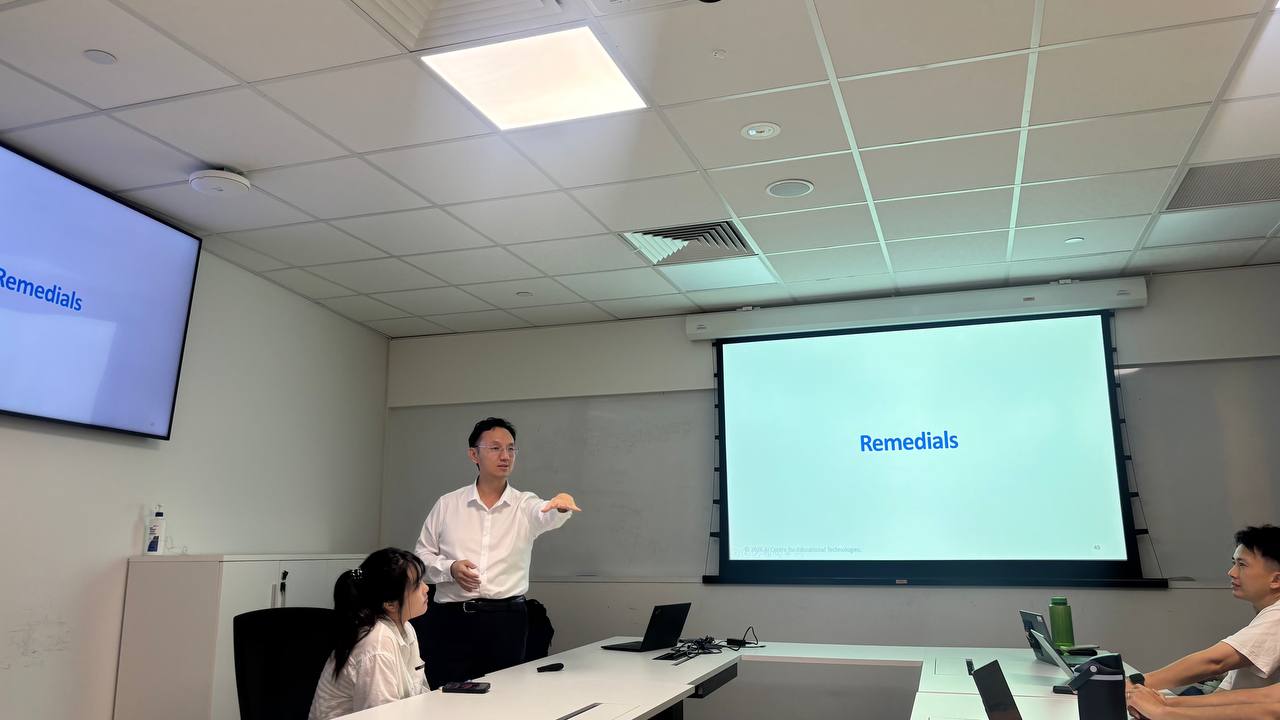
On 23 November 2026, AICET welcomed a delegation from the Home Team Science and Technology Agency (HTX), comprising members of its Training Systems and AI Products teams. The visit was hosted by Prof. Ben Leong, Director of AICET, who gave an overview of the Centre's work and shared lessons from developing and deploying AI tools in education.
A Pedagogy-First Approach
Prof. Ben opened with the principle that guides AICET's work: innovation in education is a pedagogy problem, not a technology problem. The Centre does not set out to replace teachers. Instead, it builds tools that help them teach better, by improving efficiency, enabling new approaches, making room for experimentation and improving monitoring.
He outlined the Centre's development cycle: identify real pain points, build software to address them, and iterate with real users until the solution is sustainable. Exam grading was an early target. As of July 2026, SoftMark has been used in about 70 NUS courses and about 150 MOE classes, with more than 100,000 scripts graded in each setting. Coursemology, AICET's online learning platform, has been used across 57 NUS courses and 37 MOE schools since 2013.
Role-Play for Competency-Based Learning
A large part of the session focused on ScholAIstic, AICET's agentic AI learning platform. It gives users access to 36 large language models and lets instructors see how students interact with them. Since its official launch in 2025, ScholAIstic has drawn more than 6,000 unique users and over 32,000 conversations, as of July 2026.
Prof. Ben highlighted AI role-play as a way to train skills that are hard to practise in class. Faculty in social work, nursing and law already use role-play chatbots in their courses, and AICET is building a parent engagement role-play suite for MOE teachers. He also demonstrated scenarios from his own leadership course, where students practise coaching conversations using the GROW model (Goal, Reality, Options, Will) and work through conflict management. Each exercise is structured in stages, with reflection between conversations and AI-generated feedback at the end.
His point was that anyone can build a chatbot, but an effective learning experience still depends on sound pedagogy. He also shared where the platform is heading: multi-agent scenarios, real-time chatrooms where several students and AI personas interact and instructors can join at any time, and multi-modal learning that combines voice, file uploads and document editing.
AI for Assessment and Interview Training
Prof. Ben also introduced tools that apply AI to assessment and practice. Koditsu supports online coding assessments and interviews, both live and automated, and has been used for more than 1,000 coding assessments and 500 interviews. It produces detailed assessment and interview reports to support evaluation.
KouShi addresses a different challenge: giving every student enough speaking practice ahead of Chinese oral exams. With one teacher to 40 or more students, most students get only a few minutes of live practice. KouShi's AI teacher, LaoShi, holds a real-time, two-way conversation that mirrors the exam format and gives each student a clear, actionable report.
Lessons on AI Adoption
Prof. Ben closed by sharing that adoption is often harder than it seems, as workflows differ greatly between organisations, and that more AI does not automatically mean better outcomes. AI works best as a force multiplier, and its success should be measured by learning outcomes rather than usage metrics. As he put it, the technology problems are the easy ones; the hard problems are the people problems.